


Market highlights
- Bitcoin exchange deposits surged to nearly 50,000 BTC per day throughout the last week.
- Ethereum Institutional launched, focusing on scaling, interoperability and infrastructure.
- Galaxy Digital cut the probability of the CLARITY Act becoming law in 2026 to 50%, down from 60%.
- The US Supreme Court ruled the President can remove U.S. SEC and CFTC officials without cause.
- Securitize began trading on the New York Stock Exchange and tokenised its shares on Solana and Avalanche.
- Over 140 TradFi and DeFi partners unveiled Open USD, a new dollar-backed stablecoin.
Macro market overview
TradFi risk assets continued their climb this week as market participants rotated out of semiconductor stocks and into healthcare, financials and industrials, driving the Dow to fresh all-time highs. Heading into the new week, U.S. stock futures gained as inflows into other sectors continued and concerns eased over oil flowing through the Strait of Hormuz.
U.S.-Iran peace talks have concluded for now, though they mostly focused on keeping the Strait of Hormuz open, while a more concrete agreement on ending the conflict between the nations has not yet been reached. On Sunday, 5 July, Israel launched strikes on Lebanon. With U.S. futures rising into the week, it suggests market participants' main concern is oil reaching its destination, given the economic impacts of reduced supply. Oil prices remain back just above February prices at almost US$69 per barrel.
In economic data, the U.S. non-farm employment change for June came in well below forecast at 57,000 (versus a forecast 114,000). The miss suggests steady unemployment in recent months may have contributed to inflated expectations of new jobs. June's unemployment rate came in just under forecast at 4.2%.
This week, market participants will presumably monitor developments around the Strait of Hormuz and the release of the Federal Open Market Committee's (FOMC) June 17 meeting minutes. It's otherwise a quiet week on the economic calendar.
Weekly performance: S&P 500 +1.8%, Dow Jones +2%, Nasdaq +2.1%.
Looking ahead:
- U.S. FOMC June meeting minutes - July 8
Crypto Market Performance
Market Cap: $2.21T (+0.66%)
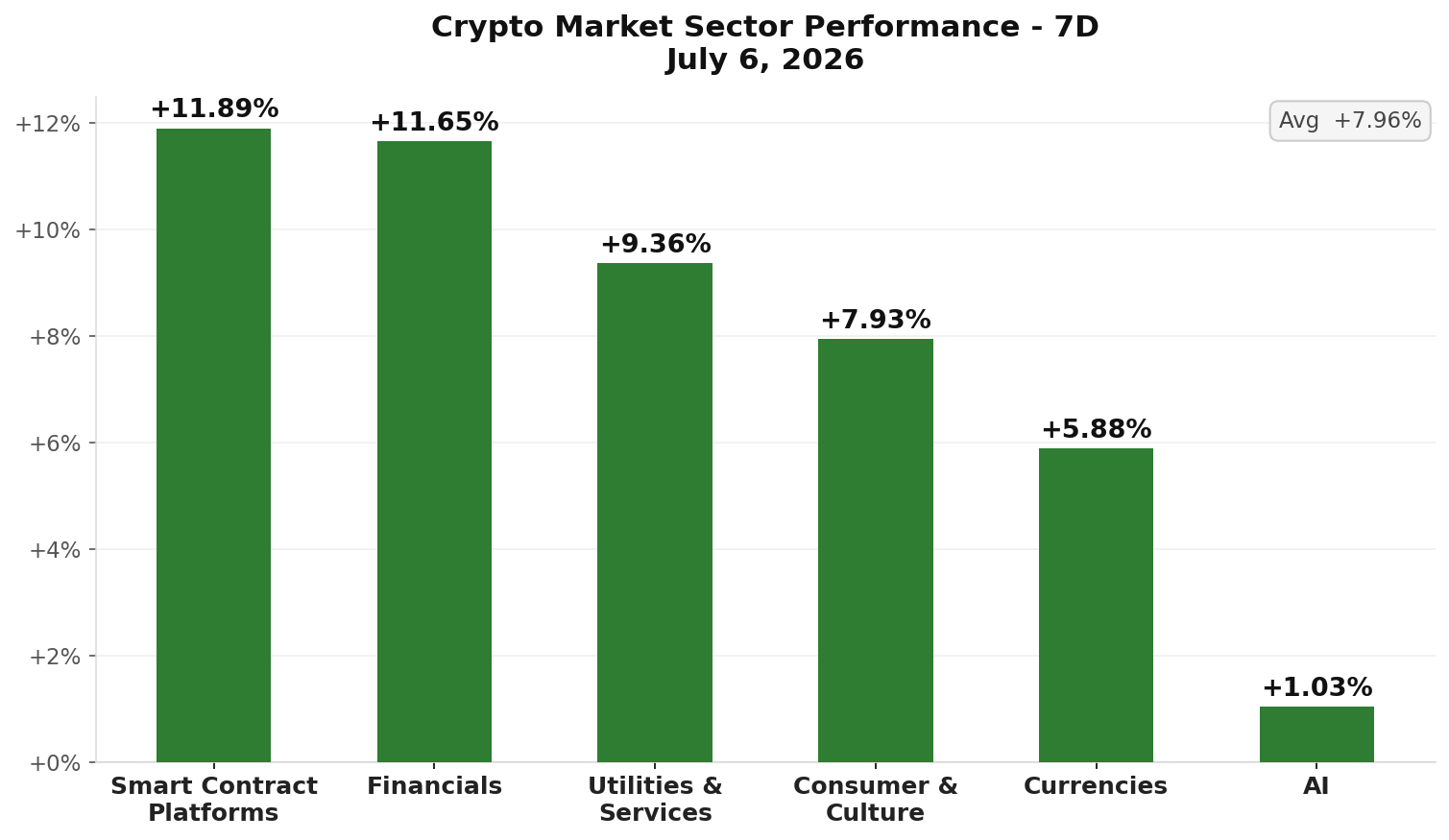
Crypto saw a bounce this week as the recent sell pressure dissipated, presumably given the declines in recent weeks became exhausted. All sectors gained, and the crypto fear and greed index gained 14 points, though it's still in fear territory at 30.
Bitcoin (BTC)
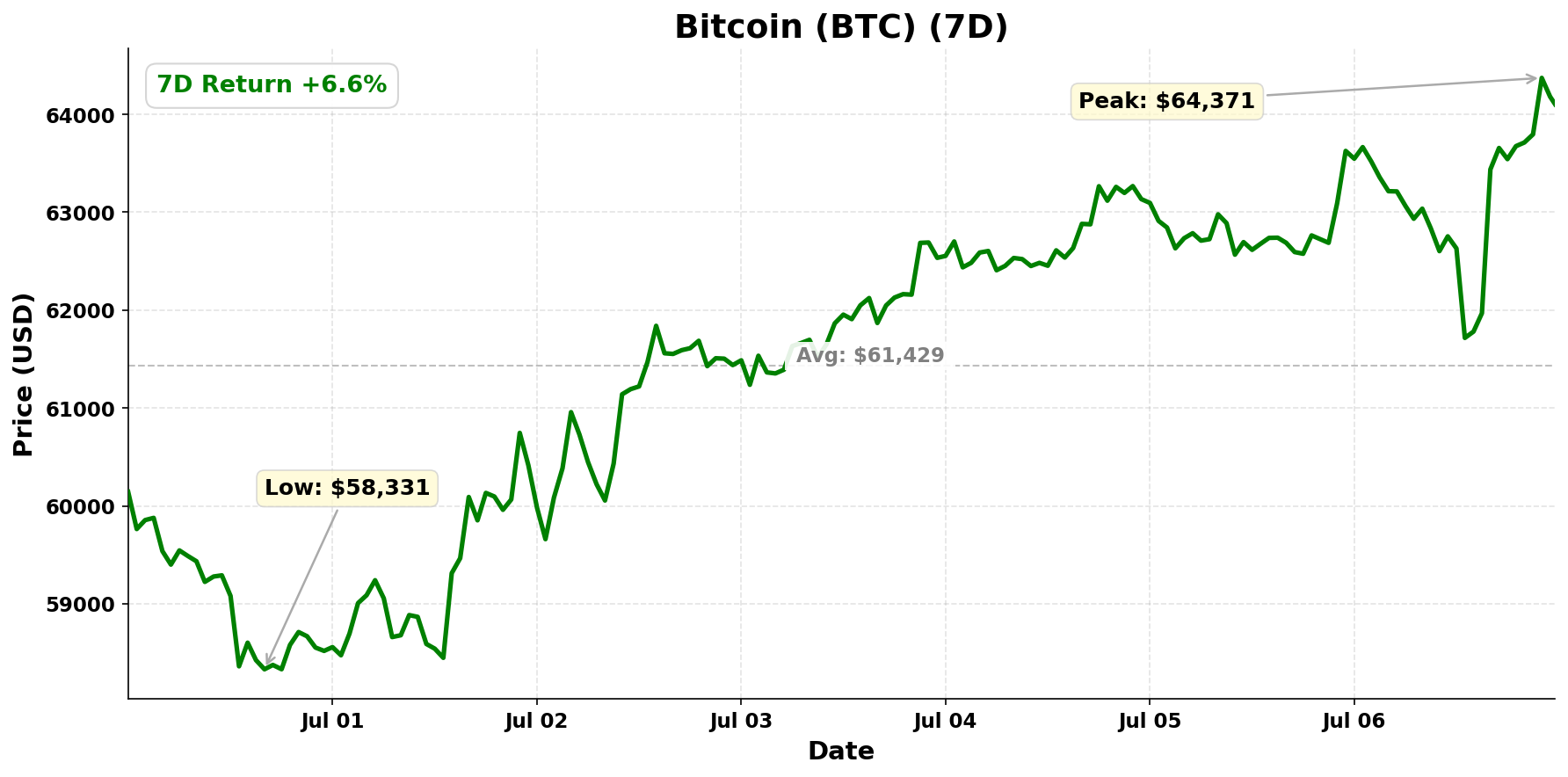
- Opened the week at US$59,473 and declined to a low of US$57,735 on Wednesday, July 1 before gaining throughout the remainder of the week. The recent gains are presumably due to increased certainty around the Strait of Hormuz re-opening and the exhaustion of recent sell pressure across crypto. Bitcoin is now trading around US$64,210 (+6.6% 7D).
- BTC dominance ranged between 58.2% and 58.6% this week.
- Bitcoin investment products saw outflows of US$479.5 million.
Bitcoin exchange deposits surged to nearly 50,000 BTC per day throughout the last week. According to CryptoQuant, deposits around these levels can precede sharp market moves. Analysts are pointing toward US$60,000 as a key area to monitor.
SBI Holdings will shut down its Bitcoin mining pool on 31 July, ending a service that ranked among the world's largest. Despite the closure, SBI continues expanding its broader crypto business, including its planned acquisition of Japanese exchange Bitbank. In other news, bitcoin mining stocks rallied after TeraWulf announced a 20-year, US$19 billion lease with AI startup Anthropic to provide data centre infrastructure. Investors welcomed the deal as further evidence miners can diversify into AI computing.
Trump-backed American Bitcoin (ABTC) carried out a 1-for-15 reverse stock split on July 2 after its share price fell to a record low of US$0.61 on Wednesday, July 1. The split aims to regain compliance with Nasdaq's listing requirements and attract institutional investors. The company says the move will not change its underlying business or bitcoin strategy but reflects ongoing pressure across crypto mining equities. ABTC shares are down 86% in the last year.
In bitcoin buying (and selling) news:
- Strategy sold 3,588 bitcoin (US$216 million) in the last week, bringing its holdings to 843,775 BTC at an average purchase price of US$63,385 per bitcoin. The sales are part of the company's "BTC Monetisation Program," and the funds will be used to pay dividends.
- Metaplanet bought 2,823 bitcoin (US$222 million) in Q2, primarily funded by debt equity. The firm now holds 43,000 BTC at an average cost of US$78,608 per bitcoin.
Past performance is not a reliable indicator of future results.
Ethereum (ETH)
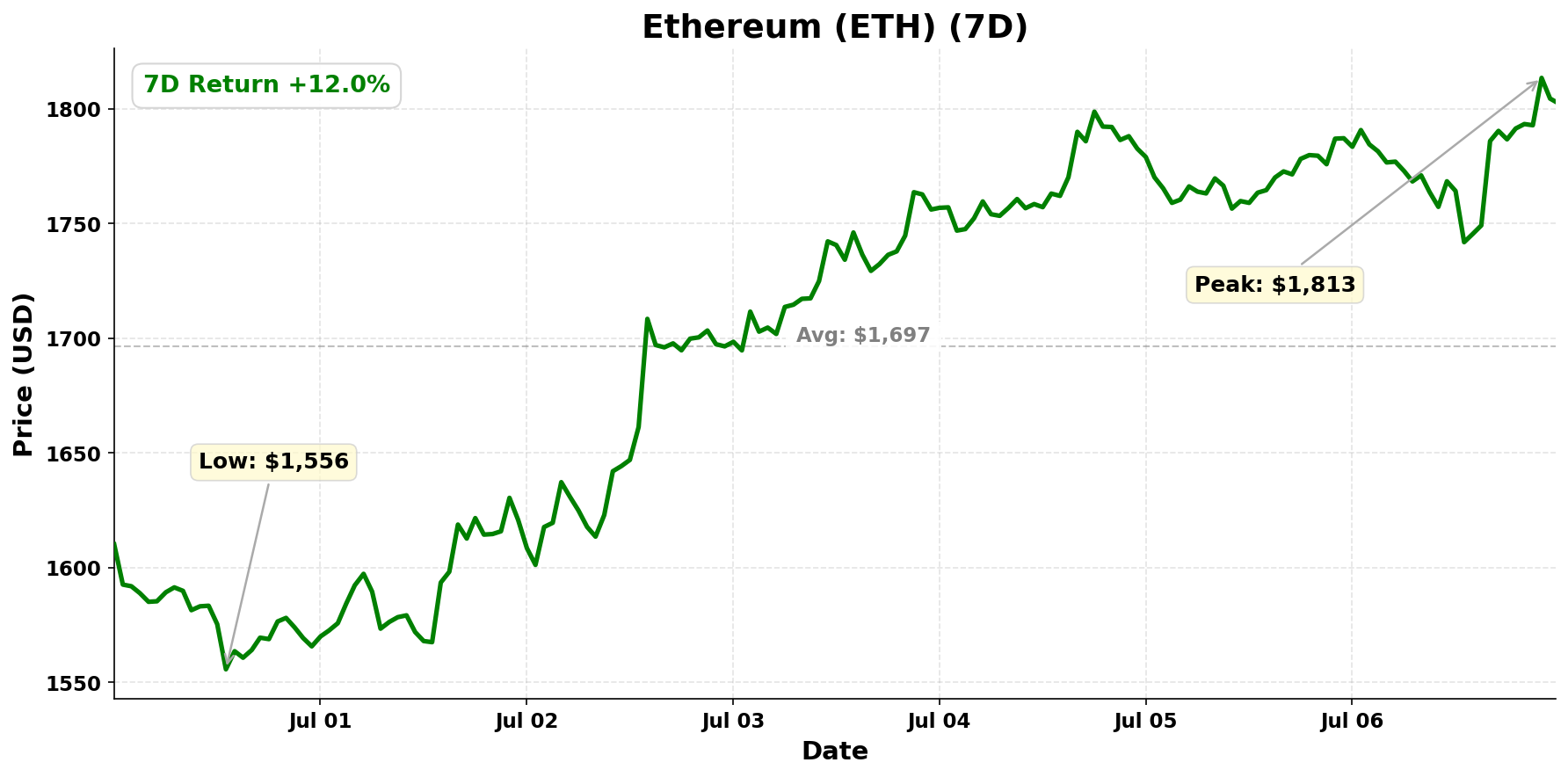
- Opened the week at US$1,569, traded sideways for much of the week, and gained to a high of US$1,806 on Sunday, July 5 as short-term sentiment improved across crypto. Ethereum is now trading around US$1,800 (+12% 7D).
- Ethereum dominance ranged between 9.3% and 10% this week.
- Ethereum-focused funds saw outflows of US$13.7 million.
Ethereum is preparing its biggest transformation since The Merge, with Vitalik Buterin outlining a sweeping overhaul to improve scalability, efficiency and user experience. The roadmap aims to strengthen Ethereum's competitiveness, simplify the protocol and support broader adoption while preserving decentralisation and the network's long-term security.
BitMine, SharpLink and Ethereum co-founder Joe Lubin have backed EthLabs, a new nonprofit research organisation founded by former Ethereum Foundation researchers. Ethereum Institutional will focus on scaling, interoperability and institutional infrastructure, aiming to prepare Ethereum for growing demand from tokenised assets, stablecoins and AI-driven commerce while complementing the Ethereum Foundation's evolving role.
In Ethereum buying news:
- BitMine bought 42,197 ETH (US$74 million). The company now holds over 5.7 million ETH, or around 4.8% of supply.
- SharpLink bought Ethereum for the first time this year, adding 10,000 ETH (US$16 million) to its portfolio. The company now holds 886,725 ETH, worth almost US$1.4 billion.
Past performance is not a reliable indicator of future results.
Altcoins
The altcoin season index is currently 48, which is altcoin season.
In the Ether
- Ether.fi gained 30% as capital rotated into select altcoins. Trading volume was up 80% throughout July 5, and the gains presumably came due to Ethereum's upward momentum this week.
Zeroed in
- LayerZero gained 27.8%. The omnichain interoperability protocol saw upside as it was featured in altcoin "rally" analysis this week and on institutional backing for its "Zero" blockchain.
- Aerodrome Finance gained 27%. The decentralised exchange and central liquidity hub for the Base network gained on growing demand in spot and derivatives markets as crypto saw a rebound this week.
Layer-1 gains
- Cardano gained 26.4%. The layer-1 network gained due to market excitement over the network's upcoming V11 'van Rossem' hard fork. The development will introduce cheaper smart contracts, new cryptographic features, and enable future scalability.
- Bitcoin Cash gained 22.2%. The hard fork from the Bitcoin network underwent the Layla Hard Fork in May 2026, which enabled the network to execute more smart contracts. This week's gains are presumably due to bitcoin's gains following recent sell pressure.
Pyth x Nasdaq
- Pyth Network gained 25.5%. The decentralised oracle network gained on news that the Nasdaq has selected Pyth as its on-chain data distributor.
Crypto ETF News
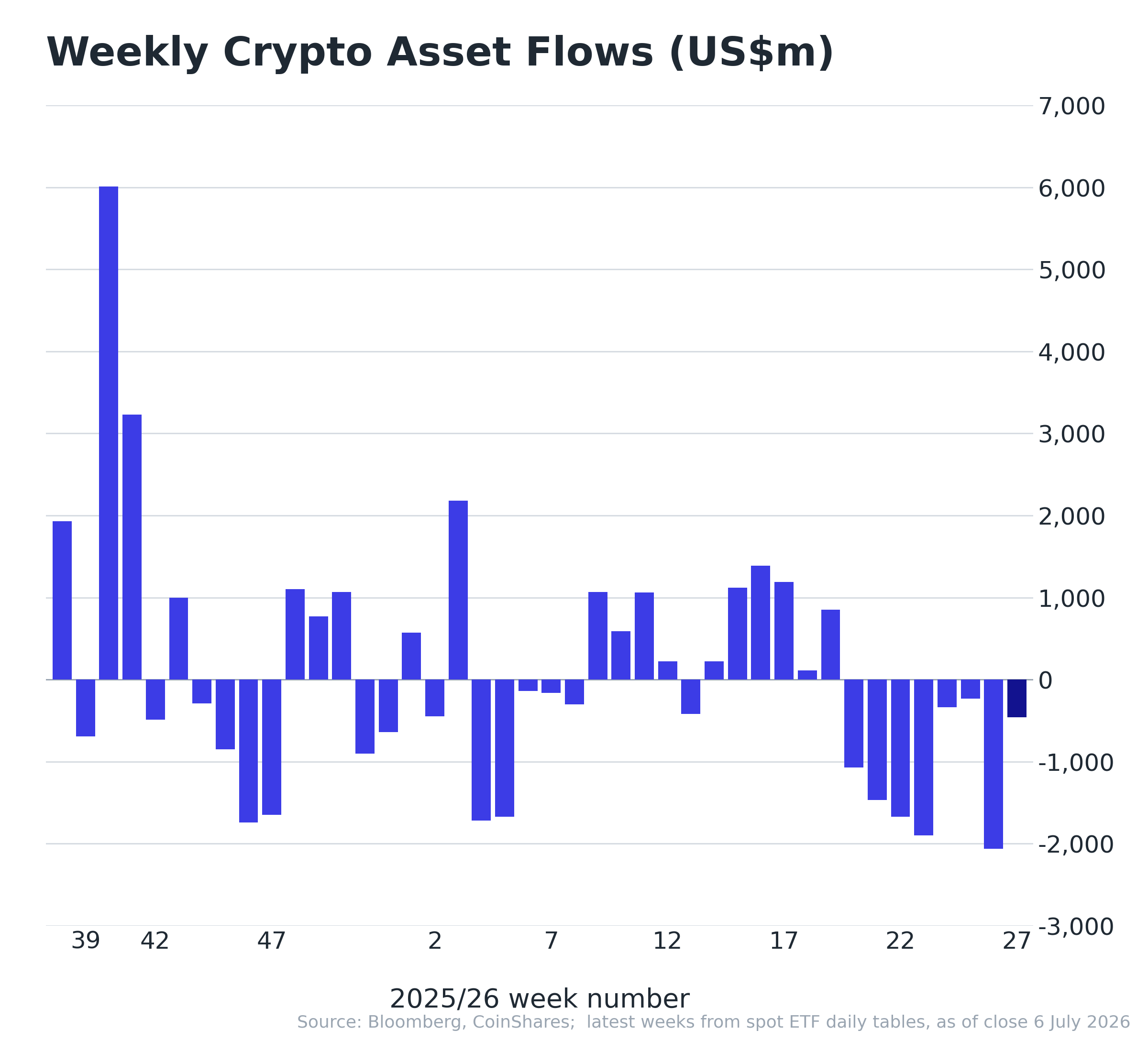
Digital asset investment products saw outflows of US$461.9 million—a considerable reduction from last week, though still a reflection of ongoing risk-off sentiment.
In altcoins, Solana, XRP and HYPE saw inflows of US$14.1 million, US$23.8 million and US$12.7 million, respectively.
Other crypto news
- Galaxy Digital cut the probability of the CLARITY Act becoming law in 2026 to 50%, down from 60%, citing a shrinking Senate calendar and competing legislative priorities. The firm stressed the downgrade reflects timing rather than opposition to the bill, with unresolved ethics provisions and limited floor time threatening its passage.
- The US Supreme Court ruled that President Trump can remove U.S. Securities and Exchange Commission (SEC) and Commodities Future Trading Commission (CFTC) officials without cause, overturning a 91-year precedent that protected independent regulators. The decision strengthens presidential control over financial regulators, with significant implications for crypto policymaking, oversight and negotiations over crypto legislation.
- US Senator Kirsten Gillibrand (D-NY) renewed calls to ban elected officials from launching or promoting meme coins. The proposal follows disclosures showing President Trump's meme coin generated US$635 million profit last year from the TRUMP meme coin alone (part of a total US$1.2 billion crypto earnings in 2025), intensifying demands for ethics safeguards alongside broader crypto legislation.
- Securitize began trading on the New York Stock Exchange while simultaneously launching tokenised versions of its shares on the Solana and Avalanche blockchains. The move marks the first newly listed public company to tokenise its own equity, advancing institutional adoption of tokenised securities and 24/7 on-chain trading.
- Shares in Circle fell almost 16% after a consortium backed by Coinbase, BlackRock, Visa, Mastercard and more than 140 partners unveiled Open USD (OUSD), a new dollar-backed stablecoin. Investors fear the revenue-sharing model could challenge USDC's dominance, intensifying competition in the global stablecoin market.
- Standard Chartered became the first global bank to offer institutional clients direct minting and redemption of Circle's USDC. Initially launching in Dubai, the service streamlines access to stablecoins for settlement, treasury and liquidity management, with expansion to additional markets planned pending regulatory approval.
- New York Life Investment Management (NYLIM) launched its first tokenised fund, a high-yield corporate bond portfolio called NYLIM Anemoy U.S. High Yield Corporate Bond Segregated Portfolio (HYB), in partnership with Centrifuge. Eligible investors can subscribe and redeem using USDC, extending Wall Street's tokenisation push beyond money market funds and Treasuries into higher-yield fixed-income assets.
- The UK's Financial Conduct Authority finalised its first comprehensive crypto rulebook, introducing licensing, capital, custody, stablecoin and market integrity requirements. The framework, effective from October 2027, aims to boost consumer protection while positioning the UK as a competitive global hub for digital assets.
- Russia says its digital ruble is ready for nationwide rollout from 1 September, with major banks and large retailers required to support the central bank digital currency. Despite the technical readiness, surveys suggest public interest remains limited as the central bank continues refining features and encouraging adoption.
- Taiwan passed its first comprehensive crypto law, introducing mandatory licensing for virtual asset service providers, strict stablecoin reserve requirements and tougher consumer protections. The legislation also imposes severe penalties for unlicensed operators and market manipulation, bringing Taiwan's regulatory framework closer to those of the European Union and other major jurisdictions.
from Caleb & Brown Cryptocurrency Brokerage.


