


Market highlights
- The OCC became the first U.S. regulator to finalise GENIUS Act rules for stablecoin issuers.
- Bitcoin briefly fell below US$80,000 amid Middle East tensions.
- HSBC launched a Hong Kong dollar stablecoin for 3.3 million PayMe app users.
- Franklin Templeton added US$150 million of tokenised fund shares to the XRP Ledger.
- Bitcoin Core will patch bugs that AI tools can easily find without the usual delay.
- JPMorgan analysts said the CLARITY Act is unlikely to pass in 2026.
Macro market overview
U.S. markets finished the week mixed as worries over artificial intelligence (AI) spending returned and oil prices climbed. Meta fell 7% on Thursday after its quarterly results and a plan to issue non-voting shares revived concerns over Big Tech's AI spending, pulling the Nasdaq down 2.6% that day, its biggest daily fall since early June, while a chip index dropped 6.7%. The S&P 500 posted its second straight weekly loss.
Investors moved into Treasuries during the sell-off, and the 10-year Treasury yield ended the week at 5.00%, down from 5.09%, after its biggest one-day fall since March 2023. Initial jobless claims fell to 194,000 against a forecast of 200,000, while S&P Global's flash purchasing managers index (PMI) survey showed selling prices rising at the fastest pace since August 2022. CME's FedWatch tool now puts the likelihood of a rate hike at the Fed's October 28 meeting at around 10%, down from around 15% a week ago, while markets still lean toward a hike in December.
Oil prices rose after Houthi attacks across Saudi Arabia and a report that the U.S. and Israel have drawn up plans to resume strikes on Iran after the November 3 midterm elections. Brent crude settled at US$116.72 a barrel, its highest close since April, while WTI settled at US$103.27. Gold fell below US$4,000 an ounce for the first time since July. Elsewhere, UK inflation rose to 3.5% in September from 3.1%.
Looking ahead, market participants will be watching the Fed's decision and any signal on December, alongside earnings from Alphabet, Microsoft and Amazon and new U.S. growth and inflation data.
Weekly performance: S&P 500 -0.5%, Dow Jones +0.4%, Nasdaq -0.7%.
Looking ahead:
- U.S. FOMC decision - Wednesday, October 28
- U.S. core PCE index - Thursday, October 29
- Bank of Japan rate decision - Friday, October 30
Crypto Market Performance
Market Cap: $2.68T (-0.6% 7D)
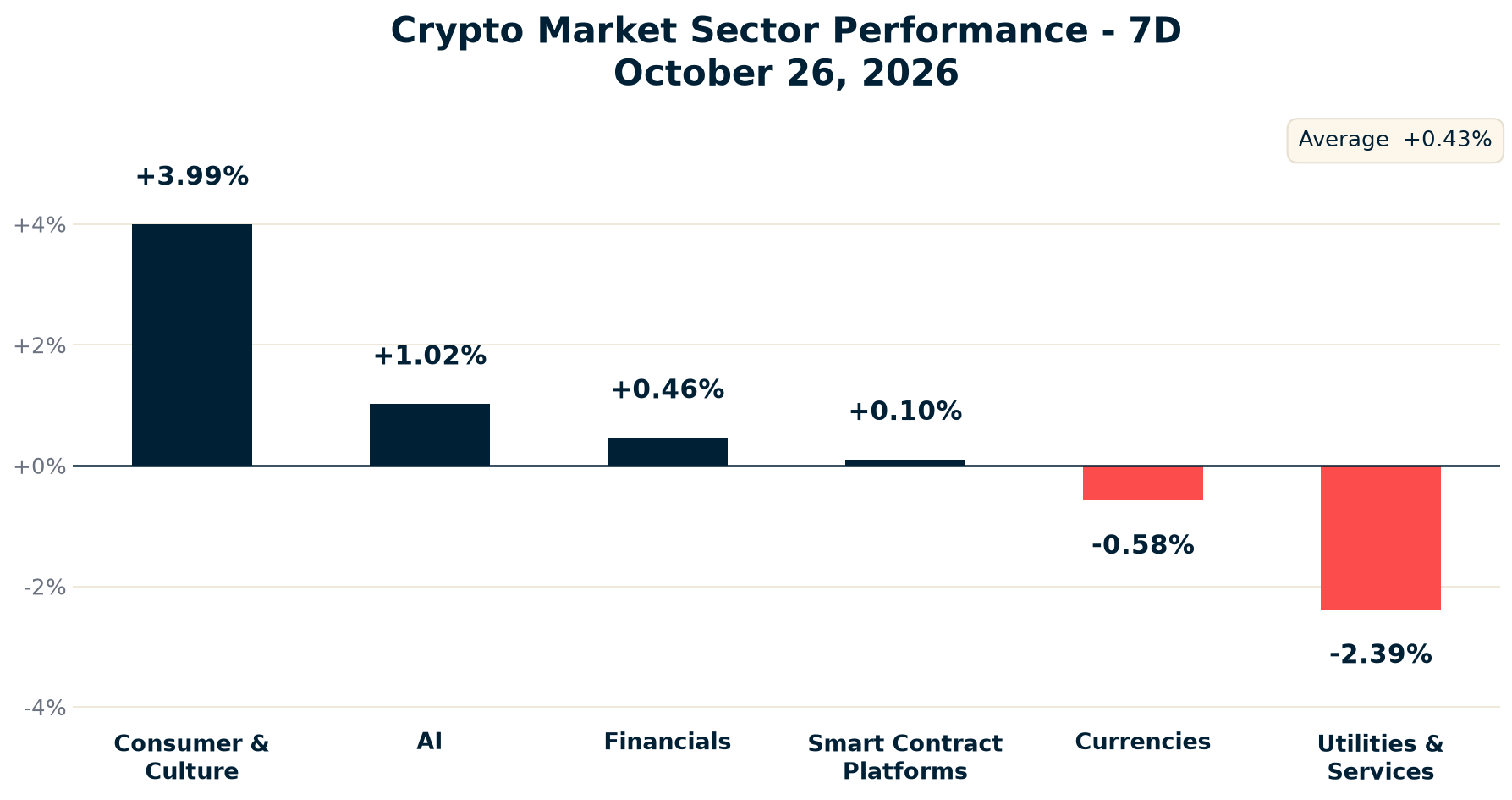
Four of six crypto sectors saw gains this week, coinciding with a late week memecoin rebound. Consumer and culture led with a 4% gain, followed by AI at 1%, while utilities and services lagged with a 2.4% decline. The crypto fear and greed index remains in "neutral" at 44, down from 49 a week ago.
Past performance is not a reliable indicator of future results.
Bitcoin (BTC)
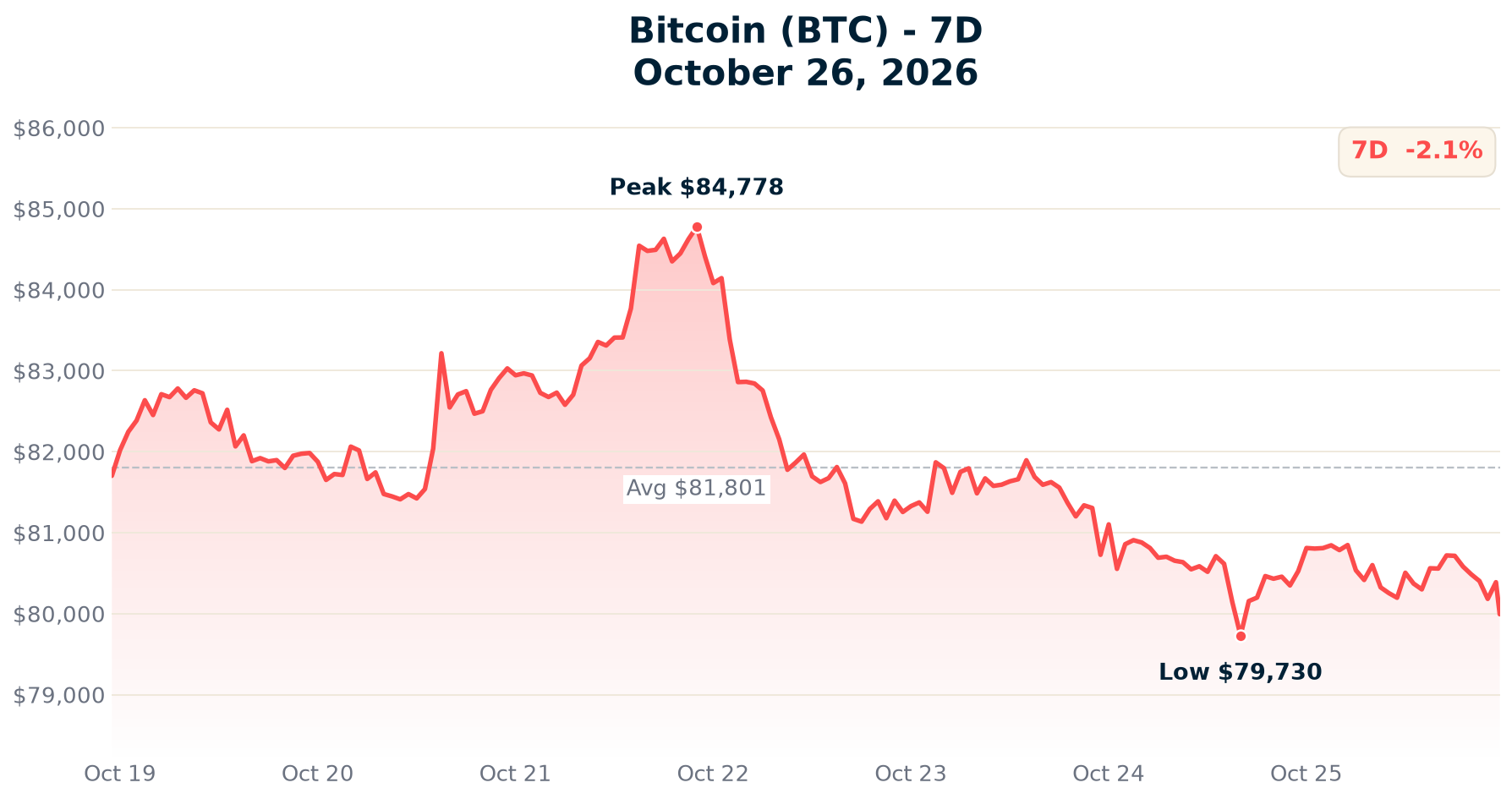
- Opened the week at US$82,020, climbed to a weekly high of US$84,778 on Wednesday, October 21, then declined, coinciding with renewed AI spending doubts and rising oil prices. Bitcoin briefly fell below US$80,000 to a weekly low of US$79,730 on Saturday, October 24, coinciding with reports of U.S. staff evacuations in the Middle East, and is now trading around US$80,146 (-2.3% 7D).
- BTC dominance ranged between 60.0% and 60.3% this week.
- Bitcoin investment products saw inflows of US$301.2 million.
Long positions worth about US$404 million were liquidated across crypto markets in four hours as bitcoin slipped below US$80,000. Bitcoin recovered above US$80,000 later that day.
Bitcoin Core developers changed the project's security policy so that bugs AI tools can easily find are fixed and released straight away across all maintained versions, rather than held back under the usual long embargo. The developers argue that AI models have made such bugs far easier to find, leaving little to gain from patching them quietly.
A wallet linked to convicted Irish drug dealer Clifton Collins, dormant since 2016, moved 500 BTC (about US$41 million) to Coinbase Prime, potentially signalling a sale by authorities, though Irish officials have not confirmed it. It was the fifth 500 BTC transfer from the wallets this year, leaving about 3,500 BTC.
Past performance is not a reliable indicator of future results.
Ethereum (ETH)
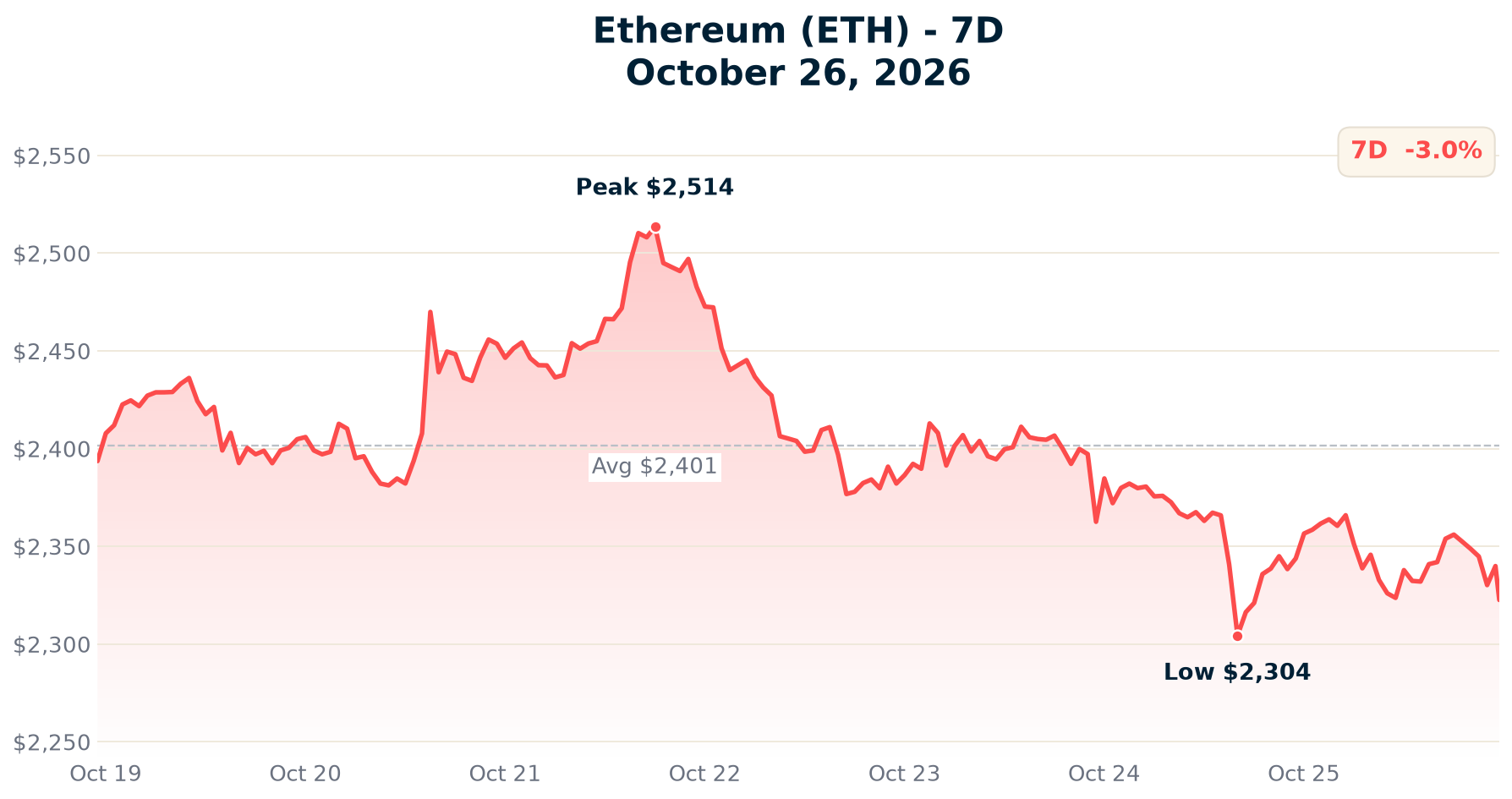
- Opened the week at US$2,408, reached a weekly high of US$2,514 on Wednesday, October 21, then declined, coinciding with the drop in AI-linked stocks, before falling to a weekly low of US$2,304 on Saturday, October 24. Ethereum is now trading around US$2,329 (-3.3% 7D).
- Ethereum dominance ranged between 10.6% and 10.9% this week.
- Ethereum-focused funds saw outflows of US$220.7 million.
Ethereum developers postponed the Glamsterdam upgrade's final test on the Hoodi test network after auditors found that its gas pricing changes could break 13 existing smart contracts. No new date has been set, putting the end-of-2026 target for the mainnet upgrade at risk.
Researchers also proposed a change that would cut the time for Ethereum transactions to become final from about 16 minutes to about four. The draft has no activation date.
Past performance is not a reliable indicator of future results.
Altcoins
The altcoin season index is currently 52, which is leaning toward altcoin season, though a broad-based rally across crypto is not present.
Swiss roll
- Venice Token gained 16.9%. The token behind privacy-focused AI platform Venice rose after 21Shares launched a Venice Token exchange-traded product (ETP) on the SIX Swiss Exchange. The physically backed product trades under the ticker VENC and charges a 2.5% annual fee.
Car-ry trade
- Kamino gained 12.2%. The Solana-based lending platform rallied after it announced fixed-rate borrowing for tokenised assets, starting with a token backed by U.S. consumer car loans. Kamino says that market grew from about US$10 million to US$135 million in its first three weeks.
Ripple effect
- XRP gained 2%. The token edged higher in a week when Franklin Templeton added about US$150 million of tokenised money market fund shares to the XRP Ledger, taking its fund's supply on the network to nearly 193 million shares. All of the new shares sit in a single wallet, and it is unclear whether they belong to one investor or several.
Alpenglow and go
- Solana's price was little changed on the week. However, its Alpenglow upgrade went live on Wednesday, October 21, replacing the consensus system Solana has run since 2020. Core developer Anza says the change cuts the time for a transaction to become final from about 12.8 seconds to about 150 milliseconds, a target under normal network conditions.
Aero-dynamics
- Aerodrome Finance declined by 11.6%. The decentralised exchange token fell after Aerodrome and Velodrome merged into a single exchange called Aero, which went live across seven networks including Ethereum and Base. Holders of both tokens are moving to a new AERO token.
Crypto ETF News
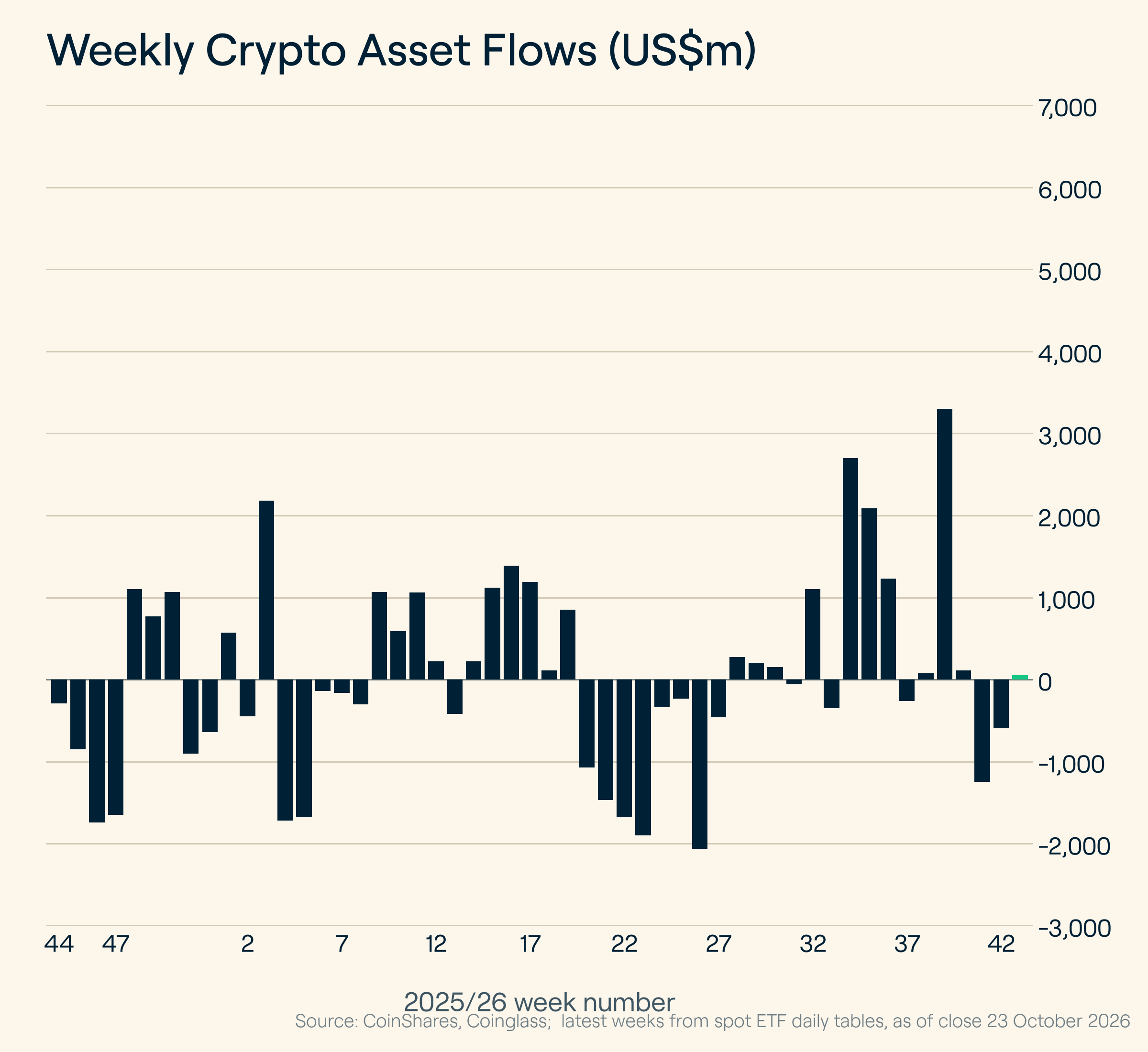
Digital asset investment products saw inflows of US$51.9 million for the week, as early-week inflows into bitcoin funds were largely offset by outflows on Thursday and Friday.
In altcoins, XRP saw inflows of US$4.3 million. Solana and HYPE saw outflows of US$17.6 million and US$15.3 million, respectively.
Switzerland's financial regulator, FINMA, approved the country's first retail exchange-traded fund (ETF) that holds bitcoin directly. Issuer BIT Asset Management plans to list the fund on the SIX Swiss Exchange in November under the ticker BBIT.
Grayscale now lets eligible investors swap their coins directly for shares in 10 of its funds, including its bitcoin, Ethereum, Solana and XRP products, without selling first. Minimum subscriptions range from about US$80,000 to US$365,000.
Past performance is not a reliable indicator of future results.
Other crypto news
- The Office of the Comptroller of the Currency (OCC) became the first U.S. regulator to finalise rules for stablecoin issuers under the GENIUS Act, setting out how banks and approved nonbank firms can issue dollar stablecoins, including requirements for reserves, redemption, custody and capital. The rules take effect on January 18, 2027. Issuers still cannot pay interest, but the OCC dropped a proposed presumption against rewards paid through third parties, drawing criticism from the American Bankers Association.
- JPMorgan analysts said the CLARITY Act is unlikely to pass in 2026, adding that regulators' recent actions only partly offset its failure and that only legislation would make the framework more durable. The bill stalled in the Senate after a 49–50 cloture vote on September 15, and Congress is in recess until after the November 3 midterm elections.
- Standard Chartered signed agreements to acquire all of Zodia Custody, the crypto custodian it backs, subject to regulatory approval. Zodia's software arm will be spun out as a separate company.
- HSBC launched RedCoin, a Hong Kong dollar stablecoin, to the 3.3 million users of its PayMe app, who can use it at more than 100,000 merchants. HSBC was one of the first two issuers licensed under Hong Kong's stablecoin rules in April, and plans to add a RedCoin wallet with tokenised investments to its banking app later this year.
- SoFi launched a tokenised deposit issued by its national bank, which it says pays 4.40% a year and is covered by Federal Deposit Insurance Corporation (FDIC) insurance. The token can be converted one-for-one into SoFi's SoFiUSD stablecoin.
- The central banks of Malaysia and Thailand joined Singapore's BLOOM project for cross-border payments using stablecoins and tokenised money, alongside participants including Ripple, Visa, Mastercard, Circle and JPMorgan. The project is still in testing, with no live payments yet.
from Caleb & Brown Cryptocurrency Brokerage.


