


Market highlights
- Crypto declined as an oil price spike and hawkish Fed signals weighed on risk assets.
- Bitcoin fell to a one-month low near US$80,650 on Thursday before recovering over the weekend.
- Digital asset investment products saw outflows of over US$1.2 billion for the week.
- BitMine said it will stop buying ETH once it holds 5% of supply.
- The U.S. government moved around US$1.8 billion of seized bitcoin, with no sale confirmed.
- Ledger is investigating thefts linked to devices sold by a Southeast Asian reseller.
Macro market overview
U.S. markets ended the week higher after a volatile few sessions, as a midweek sell-off in long-dated Treasuries and a jump in oil prices gave way to a Friday rebound. The S&P 500 closed at a record on Tuesday, October 6, before the 10-year Treasury yield rose as high as about 5.37% during Wednesday's session, its highest level since 2002. Stocks recovered on Friday, October 9, as oil prices and Treasury yields stabilised and technology shares rebounded, and the 10-year yield ended the week at 5.24%, down from 5.28% a week earlier.
Minutes of the Fed's September meeting showed most officials saw another rate hike as likely to be appropriate by year-end, while Governor Christopher Waller said he anticipates additional hikes, though not necessarily at consecutive meetings. CME's FedWatch tool now puts the likelihood of a rate hike at the Fed's October 28 meeting at 19.4%, down from 22.1% a week ago. On Friday, the University of Michigan's preliminary consumer sentiment index fell to 46.3 in October from 48.1, below forecasts, while year-ahead inflation expectations rose to 4.7%, the highest since May.
Oil prices rose as attacks on tankers in and around the Strait of Hormuz continued and Hurricane Isaias forced producers to shut in more than 70% of U.S. Gulf of Mexico crude output. Brent crude settled at US$104.72 a barrel on Friday, up 2.4% for the week, while WTI rose 0.8% to US$91.85. Into the new week, Brent reached US$107.25 on Monday, October 12, its highest level since mid-September, after Iran said a tanker had been hit in the Strait of Hormuz. Gains were presumably limited by President Trump's pledge not to strike Iran before the November 3 midterm elections and his announcement that Russia would release diesel onto global markets. The U.S. dollar index edged up 0.3% for the week, while gold rose 1.3% to around US$4,216 an ounce.
Looking ahead, the September consumer price index (CPI), due on Wednesday, October 14, will be the final major inflation reading before the Fed's October 28 decision, followed by producer prices and retail sales on Thursday. The Reserve Bank of Australia (RBA) releases the minutes of its September meeting on Tuesday, and Australia's September labour force figures are due on Thursday, October 15.
Weekly performance: S&P 500 +1.2%, Dow Jones +0.9%, Nasdaq +0.6%.
Looking ahead:
- U.S. CPI; Fed Beige Book - Wednesday, October 14
- Australian labour force; U.S. PPI; U.S. retail sales - Thursday, October 15
- U.S. industrial production - Friday, October 16
- China Q3 GDP - Monday, October 19
Crypto Market Performance
Market Cap: $2.81T (-3.9% 7D)
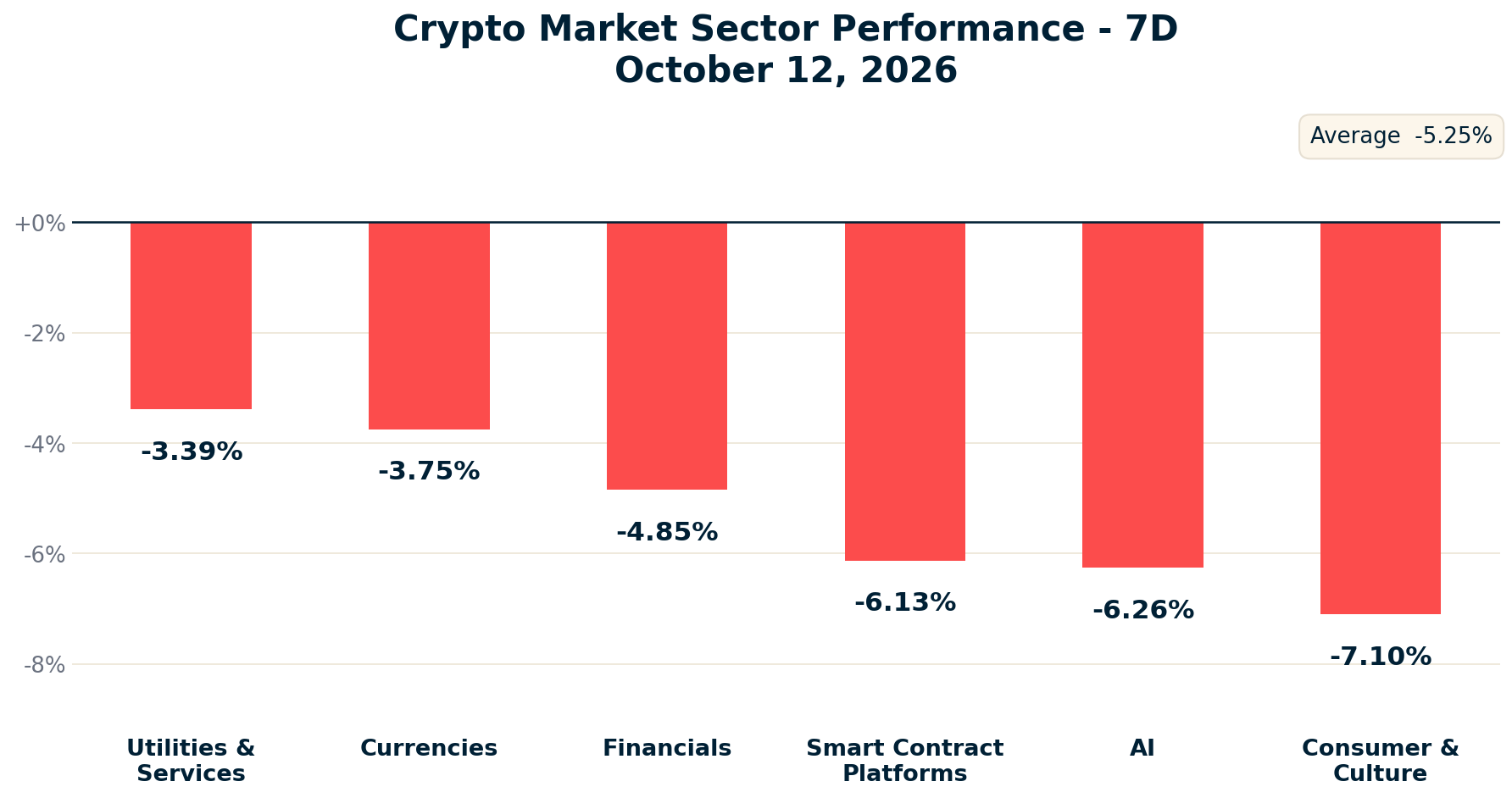
All crypto sectors saw losses this week as an oil price spike, a sell-off in long-dated Treasuries and hawkish Fed signals weighed on risk assets. Utilities and services held up best with a 3.4% decline, followed by currencies at 3.8%, while consumer and culture lagged with a 7.1% decline. The crypto fear and greed index has slipped to "neutral" at 56, down from "greed" at 67 a week ago.
Past performance is not a reliable indicator of future results.
Bitcoin (BTC)
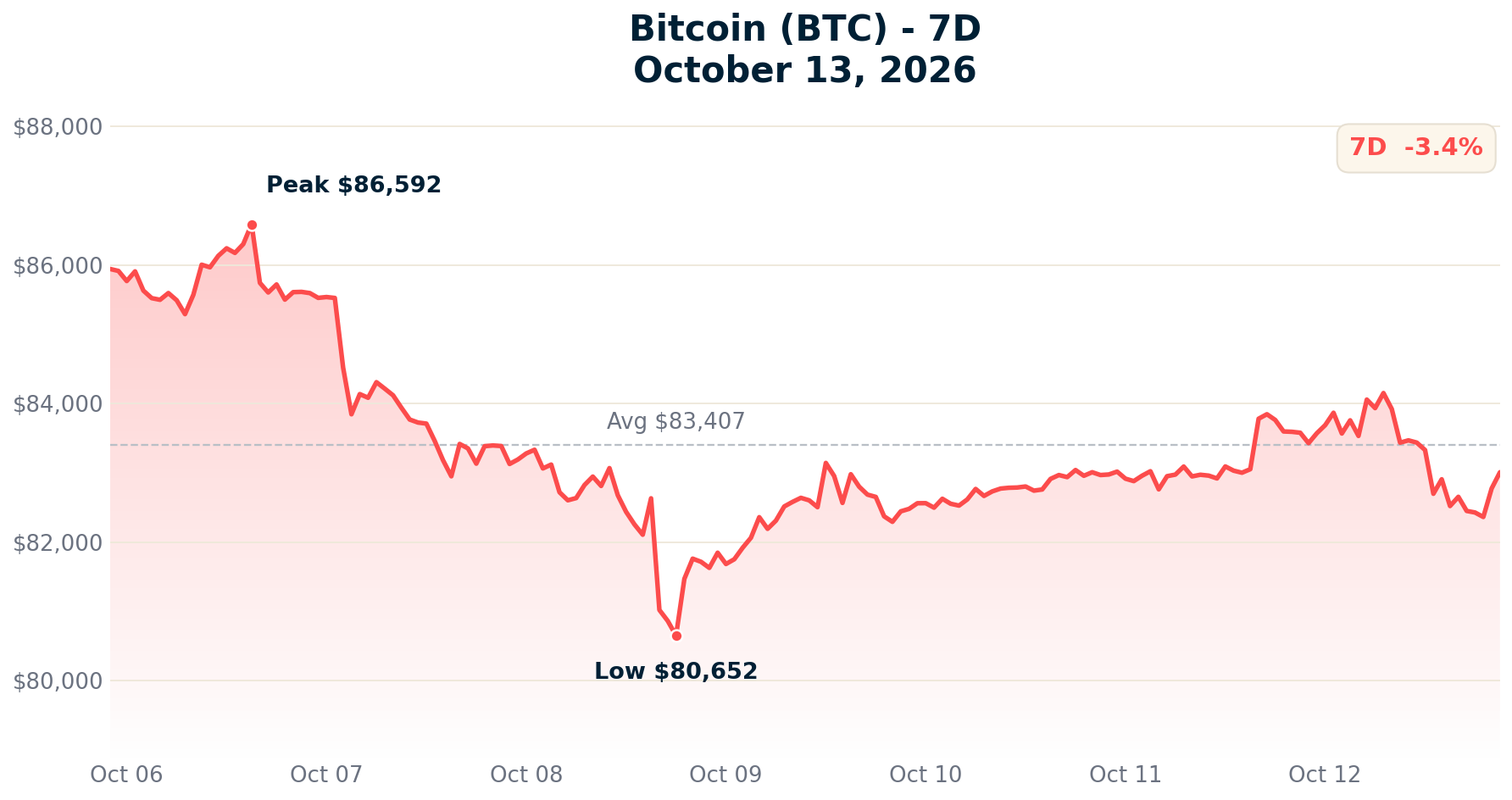
- Opened the week at US$85,945, reached a weekly high of US$86,592 on Tuesday, October 6, then declined from Wednesday, coinciding with a spike in oil prices and a sell-off in long-dated Treasuries, before falling to a weekly low of US$80,652 on Thursday, October 8. Bitcoin recovered over the weekend after President Trump said the U.S. would not strike Iran before the midterm elections, then eased on Monday, coinciding with a further rise in oil prices, and is now trading around US$82,823 (-3.6% 7D).
- BTC dominance ranged between 59% and 59.7% this week.
- Bitcoin investment products saw outflows of US$678.9 million.
Wallets linked to the U.S. government moved around US$1.8 billion of seized bitcoin over three days, including 9,261 BTC sent to Coinbase Prime, the U.S. Marshals' custodian, and 12,267 BTC (about US$1 billion) from the Bitfinex hack seizure wallet to a new address on Thursday, October 8. No sale has been confirmed, and a March 2025 executive order directs forfeited bitcoin into the Strategic Bitcoin Reserve. The government still holds around 306,795 BTC, according to Arkham.
Ethereum Foundation researcher Justin Drake urged the industry to prepare for "bunker mode", warning that AI-accelerated mathematics could break the signature schemes that protect bitcoin and Ethereum wallets, in the worst case "in months not years". Ethereum co-founder Vitalik Buterin said the risk is plausible within two years, but that he does not recommend anyone scramble to move funds to new wallets. According to Glassnode, more than 6 million BTC, or 31.2% of supply, sits behind public keys already visible on-chain. No practical attack has been demonstrated.
In bitcoin buying news:
- Strategy bought 250 bitcoin (US$21.5 million), bringing its holdings to 848,250 BTC (over US$70 billion) at an average purchase price of US$75,444 per bitcoin. The company also spent US$192.4 million buying back its STRC preferred shares.
- Robinhood bought around US$25 million of bitcoin for its own balance sheet, its first corporate bitcoin purchase, according to the company's head of crypto, Johann Kerbrat.
Past performance is not a reliable indicator of future results.
Ethereum (ETH)
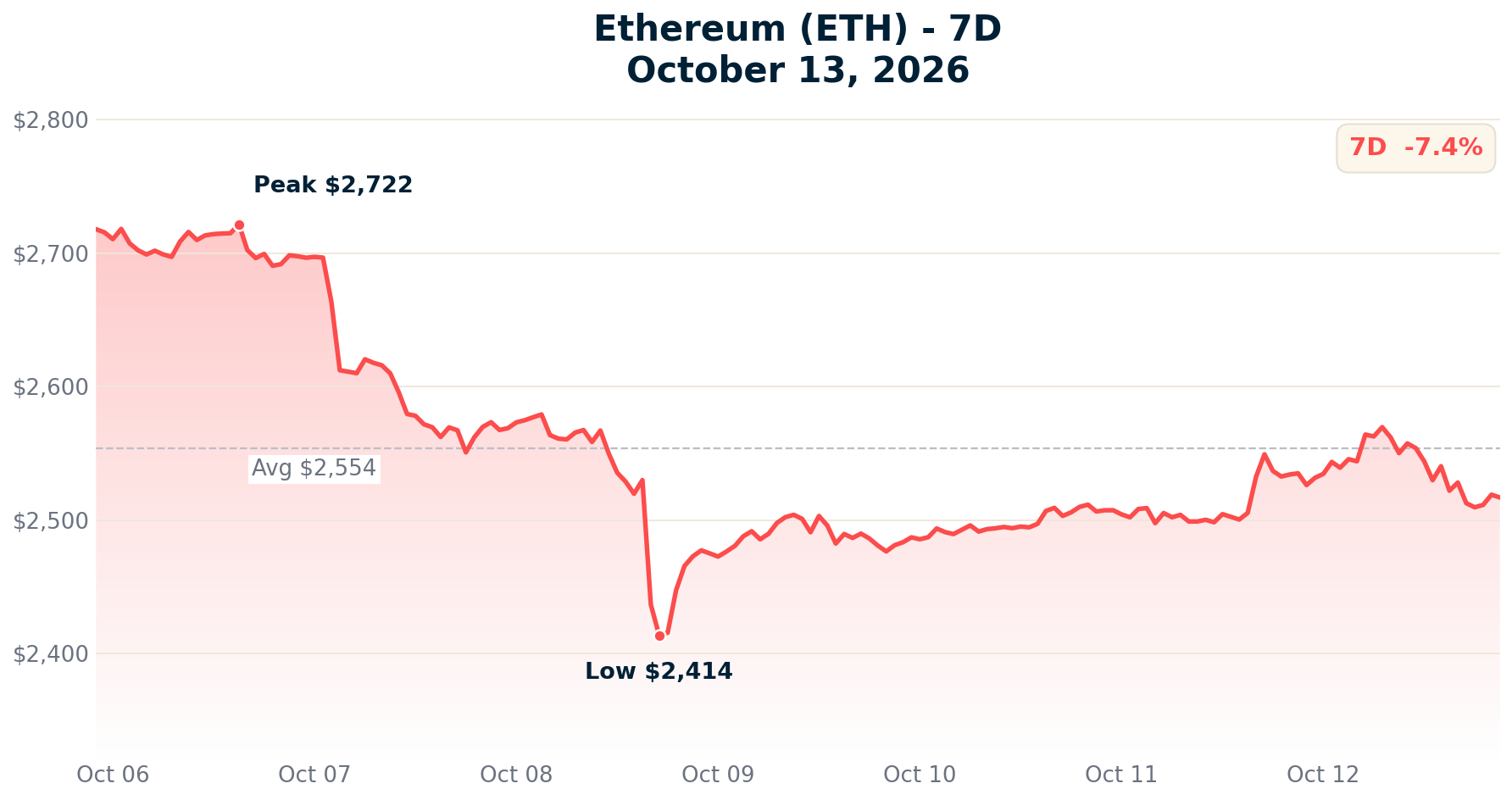
- Opened the week at US$2,718, reached a weekly high of US$2,722 on Tuesday, October 6, then declined through the middle of the week, coinciding with a wave of leveraged liquidations, before falling to a weekly low of US$2,414 on Thursday, October 8. Ethereum recovered into the weekend before easing on Monday, and is now trading around US$2,508 (-7.7% 7D).
- Ethereum dominance ranged between 10.8% and 11.3% this week.
- Ethereum-focused funds saw outflows of US$542.2 million.
BitMine's Tom Lee said the company will stop buying Ethereum once it holds 5% of supply, describing the level as a "hard cap" at Token2049 in Singapore on Wednesday, October 7. In its latest update, BitMine said it is "99% of the way" to the target, leaving roughly 76,000 ETH to buy.
In Ethereum buying news:
- BitMine bought 12,532 ETH (around US$32 million). The company now holds over 6 million ETH, worth around US$15.1 billion, or around 4.9% of supply. Over 5 million of BitMine's holdings are staked.
Past performance is not a reliable indicator of future results.
Altcoins
The altcoin season index is currently 61, which is leaning toward altcoin season, though a broad-based rally across crypto is not present.
Data-driven
- Celestia gained 16.2%. The modular data availability network rose after options exchange Derive launched its V3 platform on Thursday, October 8, with its trading data now posted to Celestia. Derive has cleared around US$14.2 billion in options volume so far this year, and TIA reached its highest level of 2026 on Sunday, October 11, at around US$0.63.
Seoul searching
- Kaia gained 15.5%. The layer-1 blockchain rallied after South Korean exchange Upbit added KAIA trading against the won, bitcoin and Tether on Friday, October 9. KAIA rose as much as 64% during the session to around US$0.06, its highest level this year.
Chain reactions
- Monad declined by 20.5%. The losses came after developer Category Labs unveiled Monad Private Settlement, a design for confidential transactions aimed at banks and asset managers, at its Singapore summit on Tuesday, October 6. The feature is not yet live and has no launch date, while around US$521 million worth of MON is scheduled to unlock on November 24.
Ripple effect
- XRP declined by 9%. Evernorth, a Ripple-backed company holding around 473 million XRP, began trading on Nasdaq under the ticker XRPN on Monday, October 12, after completing its merger with Armada Acquisition Corp. II on Friday, October 9. Around 80% of Armada's public shareholders redeemed their shares before the listing, and Evernorth also holds around US$300 million in cash.
Crypto ETF News
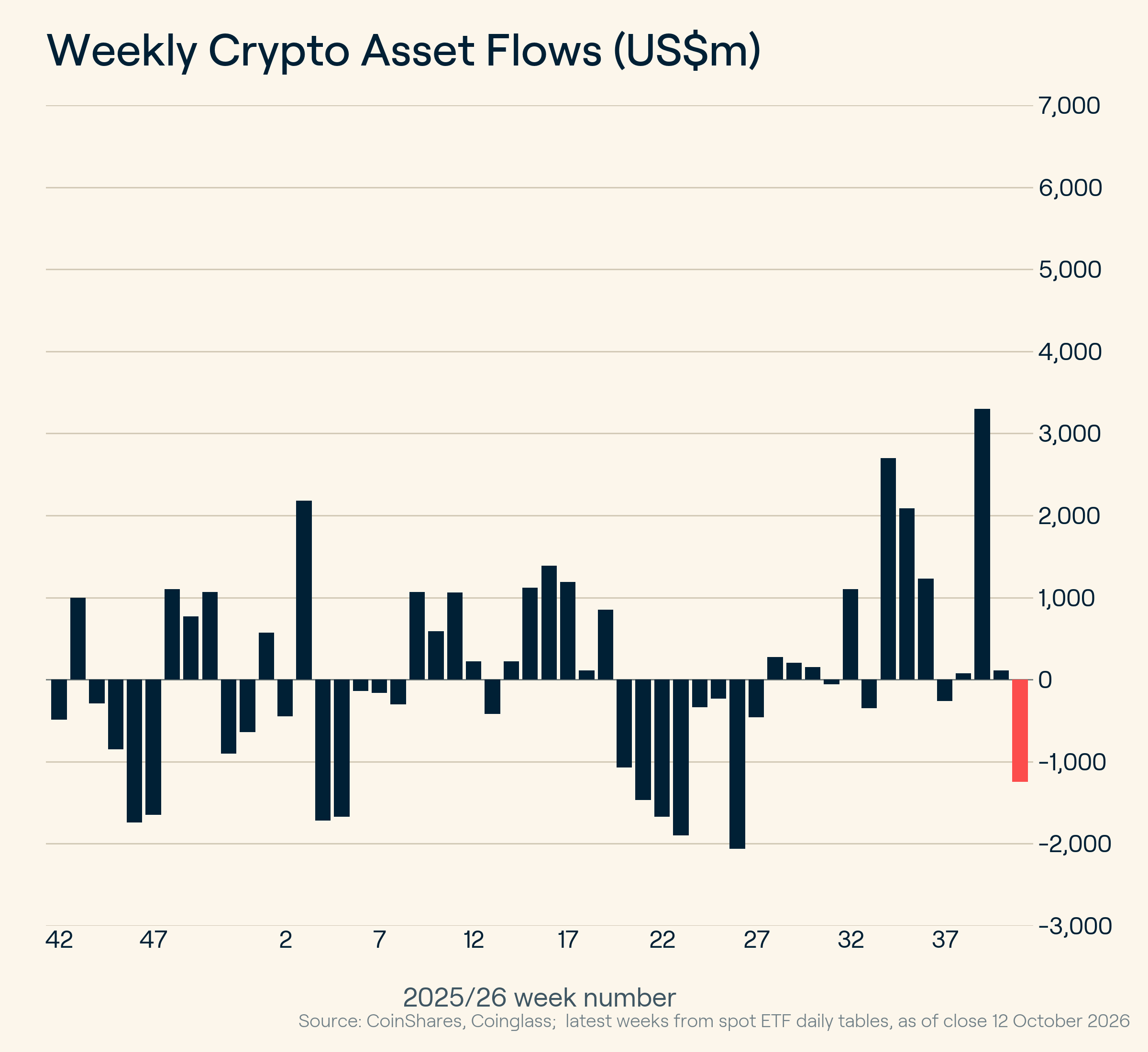
Digital asset investment products saw outflows of over US$1.2 billion for the week, as Bitcoin funds recorded their largest daily outflow since June on Wednesday, October 7, and Ethereum-focused funds extended their outflow streak to nine trading days.
In altcoins, XRP saw inflows of US$11.3 million. Solana and HYPE saw outflows of US$25 million and US$9.4 million, respectively.
Thailand's Securities and Exchange Commission finalised rules allowing spot bitcoin and Ethereum ETFs to list on the Stock Exchange of Thailand, effective October 16. Separately, Bitwise said it will close its Dogecoin ETF, with trading set to end after October 14.
Past performance is not a reliable indicator of future results.
Other crypto news
- The CFTC proposed treating prediction-market event contracts as swaps on Friday, October 9, covering contracts on sports, politics, culture and weather, with a 30-day comment period. A separate interim final rule, effective immediately, excludes casino-style gambling from the swap definition. The moves come as several states challenge the agency's authority over prediction markets, with the dispute now before the Supreme Court.
- Treasury Secretary Scott Bessent said on Thursday, October 8 that the U.S. would "probably" seize US$1 billion in Iran-linked crypto within the week, adding "we know where it is". He did not identify the wallets or assets involved, and no seizure had been announced as of Monday, October 12. The Treasury has sanctioned seven Iranian crypto exchanges since June.
- House Financial Services Committee Chair French Hill said recent SEC and CFTC actions "fall short" of what the CLARITY Act would provide, and that he still hopes the bill can pass in the lame-duck session after the November 3 midterm elections. The bill remains stalled in the Senate after a 49–50 cloture vote on September 15, and no new floor vote has been scheduled.
- Samsung will let U.S. users of Samsung Wallet and Samsung Pay send USDC across borders on the Solana network from the last week of October. The feature will be available on around 82 million Galaxy devices in the U.S.
- Standard Chartered plans to offer institutional custody of crypto, stablecoins and tokenised assets in Singapore through its digital asset custodian Zodia. The bank did not give a launch date or name the assets it will support.
- The European Securities and Markets Authority (ESMA) gave EU crypto platforms until January 8, 2027 to wind down exposure to stablecoins that are not authorised under MiCA, such as USDT and PYUSD. Platforms must stop letting EU clients buy, trade or increase holdings of non-compliant stablecoins, although selling, converting and withdrawing remain allowed.
- The Financial Stability Board (FSB), the G20's financial watchdog, warned that global stablecoins have not been tested under severe stress, and called on regulators to share more information across borders and plan for an issuer's distress or failure. The recommendations are not legally binding. The report comes ahead of a meeting of G20 finance ministers and central bank governors on Thursday, October 15.
- Ledger said it is investigating reports that users in Southeast Asia lost funds after buying devices from authorised reseller CryptoBilis, and later confirmed that one affected device contained an unauthorised hardware implant. On-chain investigator Specter estimated losses at more than US$86 million, though Ledger has not confirmed the figure. On Monday, October 12, Ledger said all confirmed cases are tied to CryptoBilis, which has stopped selling hardware wallets, and that its own systems and direct sales were unaffected. It advised anyone who bought from the reseller in the past 90 days not to set up their device.
Inside the Markets
Crypto finished September higher despite a Fed rate hike, rising bond yields and a setback for the CLARITY Act. Bitcoin ETF demand helped support the recovery.
In this month's Inside the Markets, we look at how crypto held up through the Fed's first rate hike since 2023, rising Treasury yields, oil above US$100 and the CLARITY Act's Senate setback, and the key catalysts for October.

from Caleb & Brown Cryptocurrency Brokerage.


