


Market highlights
- MSCI confirmed it will remove Strategy from its global indexes after November 30.
- President Trump nominated four people to SEC and CFTC seats, two from each major party.
- The U.S. Supreme Court declined Custodia Bank's bid for a Federal Reserve master account.
- CFTC Chair Michael Selig announced approval of a blockchain-based derivatives exchange.
- DBS and JPMorgan linked their deposit networks for round-the-clock U.S. dollar transfers.
- Bitcoin fell to its lowest level since July, briefly dropping below US$63,000.
Watch this week's Weekly Rollup

Macro market overview
U.S. markets ended higher for the week, with the S&P 500 posting its best week since early August, despite a slide in Nvidia shares after Chief Executive Jensen Huang resigned on Thursday. Chief Financial Officer Colette Kress is serving as interim chief executive, and Nvidia said its quarterly results would be released on Tuesday as scheduled. Chip stocks led a decline on Friday that pulled the Nasdaq down 0.9%, and the selling deepened on Monday, when the Nasdaq fell 2.5% ahead of Nvidia's results.
Treasury yields climbed after hot U.S. inflation data early in the week, with the 10-year yield rising to 5.15% from 4.86% and the 2-year yield to 4.88% from 4.51%. U.S. producer prices rose 0.3% in October, below a forecast 0.4%, though they were up 6.5% from a year earlier, the largest annual rise since November 2022. Boston Fed President Susan Collins backed a steady, gradual path of rate increases, while Chicago Fed President Austan Goolsbee said inflation was moving in the wrong direction. As of Monday, CME's FedWatch tool put the likelihood of a rate hike at the Fed's December 9 meeting at 100%, including a 4.3% chance of a half-point hike.
Oil prices fell for a second week, with Brent crude settling at US$95.84 a barrel and West Texas Intermediate at US$88.56, both down about 2.5%, as the International Energy Agency projected a growing global supply surplus. President Trump said a deal with Iran was not necessary to end the war. The U.S. dollar index rose above 103 on Friday, its highest level since April 2025. Elsewhere, the UK economy grew 0.7% in the third quarter.
Looking ahead, AI developer Anthropic is expected to list on Nasdaq this week in an offering that could raise as much as US$64.4 billion, which at least one analyst linked to crypto selling as investors raised cash for allocations.
Weekly performance: S&P 500 +2.5%, Dow Jones +2.1%, Nasdaq +2.3%.
Looking ahead:
- U.S. retail sales - Tuesday, November 17
- Nvidia earnings - Tuesday, November 17
- U.S. FOMC meeting minutes - Wednesday, November 18
Crypto Market Performance
Market Cap: $2.22T (-11.6% 7D)
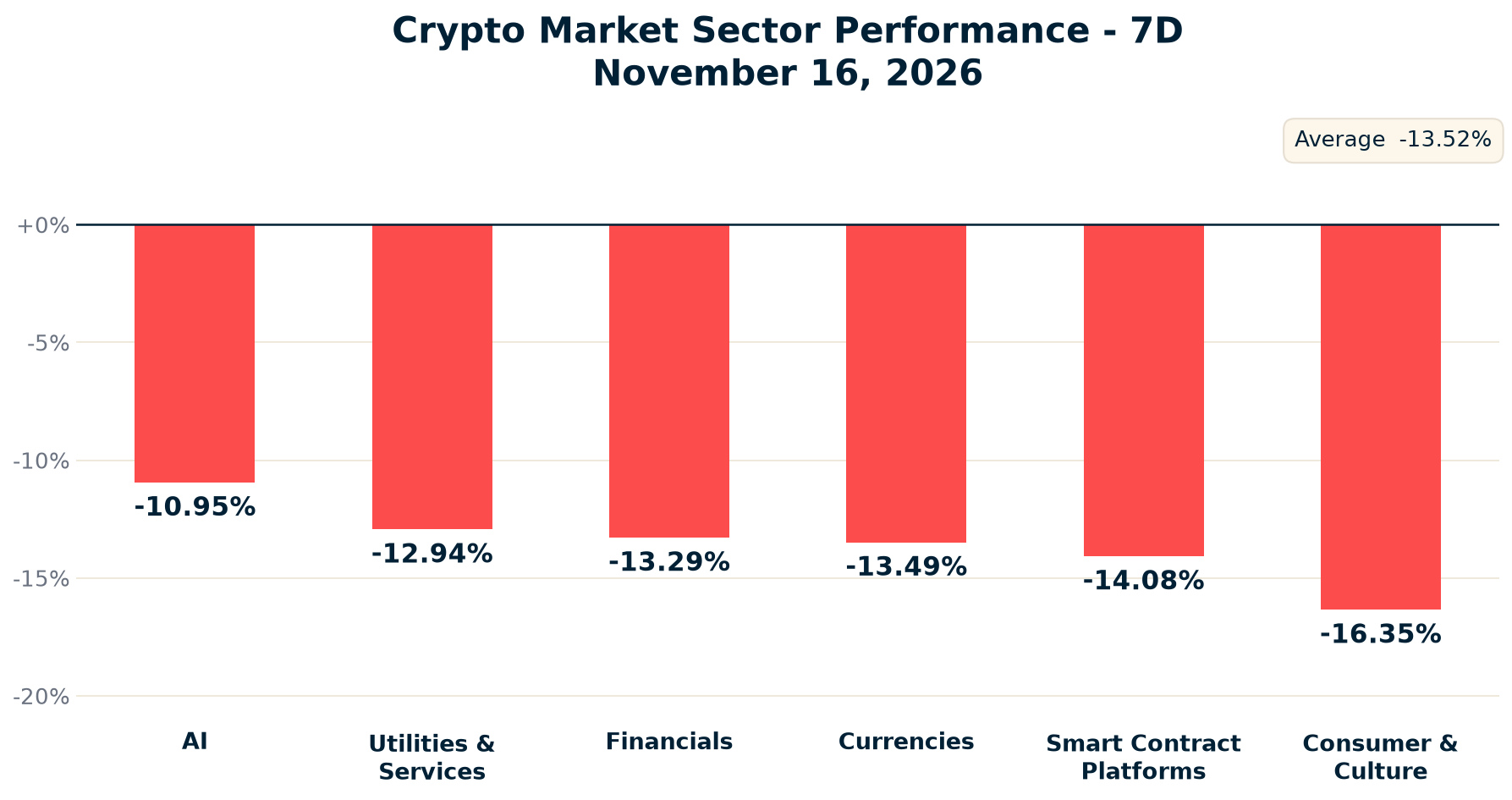
All crypto sectors saw losses this week, coinciding with higher U.S. bond yields and continued outflows from crypto exchange-traded funds. AI held up best with a 10.9% decline, followed by utilities and services at 12.9%, while consumer and culture lagged with a 16.3% decline. The crypto fear and greed index has fallen to "Extreme fear" at 13, down from 26 a week ago.
Past performance is not a reliable indicator of future results.
Bitcoin (BTC)
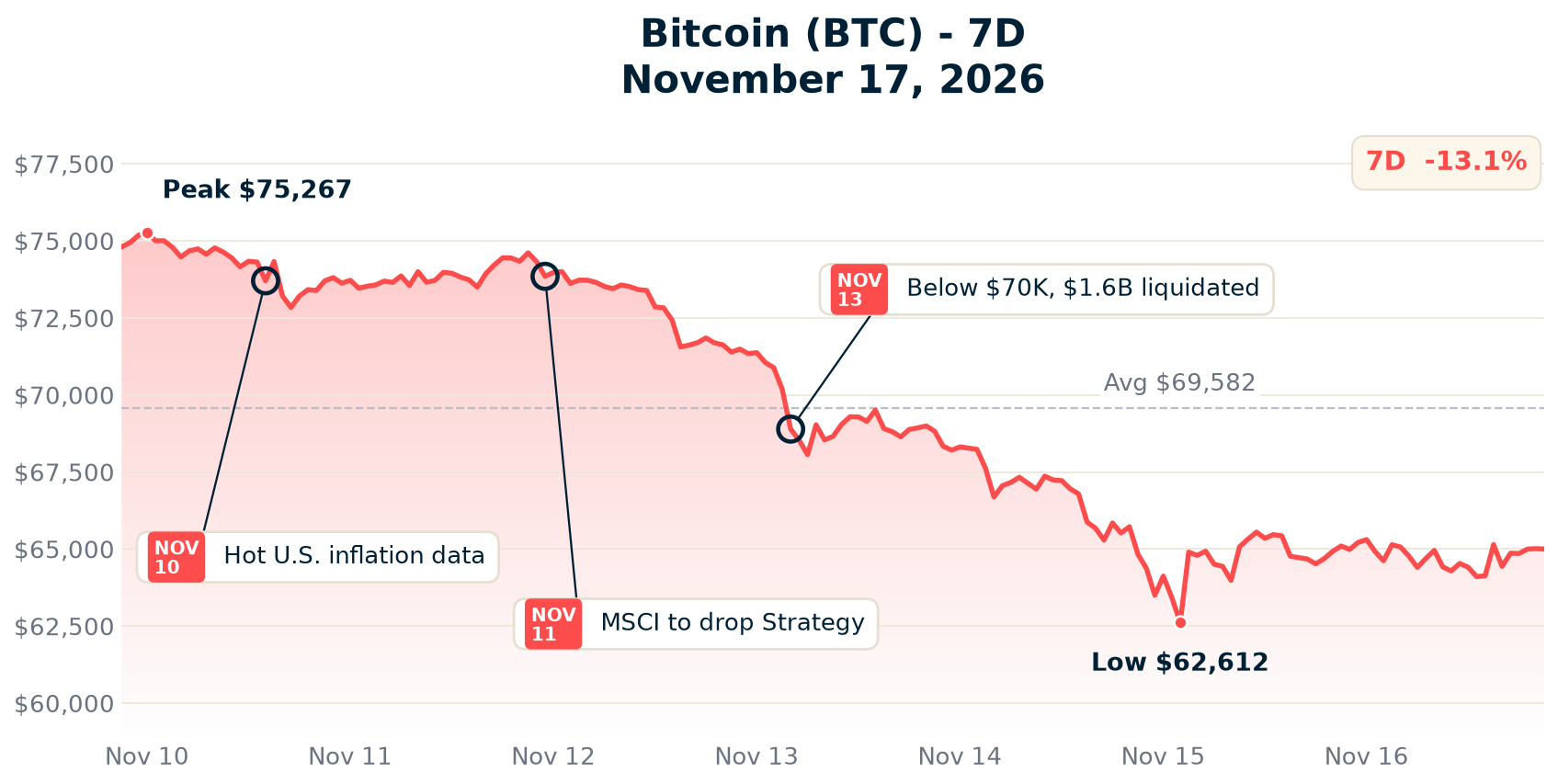
- Opened the week at US$74,804 and declined for most of the week as U.S. bond yields rose and crypto funds saw outflows, before falling to a weekly low of US$62,612 on Sunday, November 15. Bitcoin is now trading around US$65,000 (-13.1% 7D).
- BTC dominance ranged between 59.3% and 60.6% this week.
- Bitcoin investment products saw outflows of US$1.07 billion, a second straight week of outflows above US$1 billion.
Bitcoin fell below US$70,000 on November 13 for the first time since August, and more than US$1.6 billion of leveraged crypto positions was liquidated in 24 hours, most of them bets on higher prices. It dropped below US$63,000 over the weekend, its lowest level since July. The combined market value of the two largest stablecoins, USDT and USDC, has also fallen by about US$17 billion in a month, potentially leaving less cash on hand for crypto purchases.
Index provider MSCI confirmed it will remove Strategy from the MSCI USA Index and its global indexes after the close on November 30, under its new rules for companies that mainly hold digital assets. Funds tracking MSCI indexes are estimated to hold about 13 million Strategy shares, and the change does not require the company to sell any bitcoin. Japan's Metaplanet will also leave the MSCI Japan Small Cap Index.
In bitcoin buying news:
- Strategy bought 485 bitcoin (US$33.4 million), bringing its holdings to 850,849 BTC (about US$55 billion) at an average purchase price of US$75,452 per bitcoin. The company also spent US$228.1 million buying back its STRC preferred shares.
- Strive bought 251 bitcoin (about US$17.5 million), bringing its holdings to 43,404 BTC (about US$2.8 billion).
Past performance is not a reliable indicator of future results.
Ethereum (ETH)
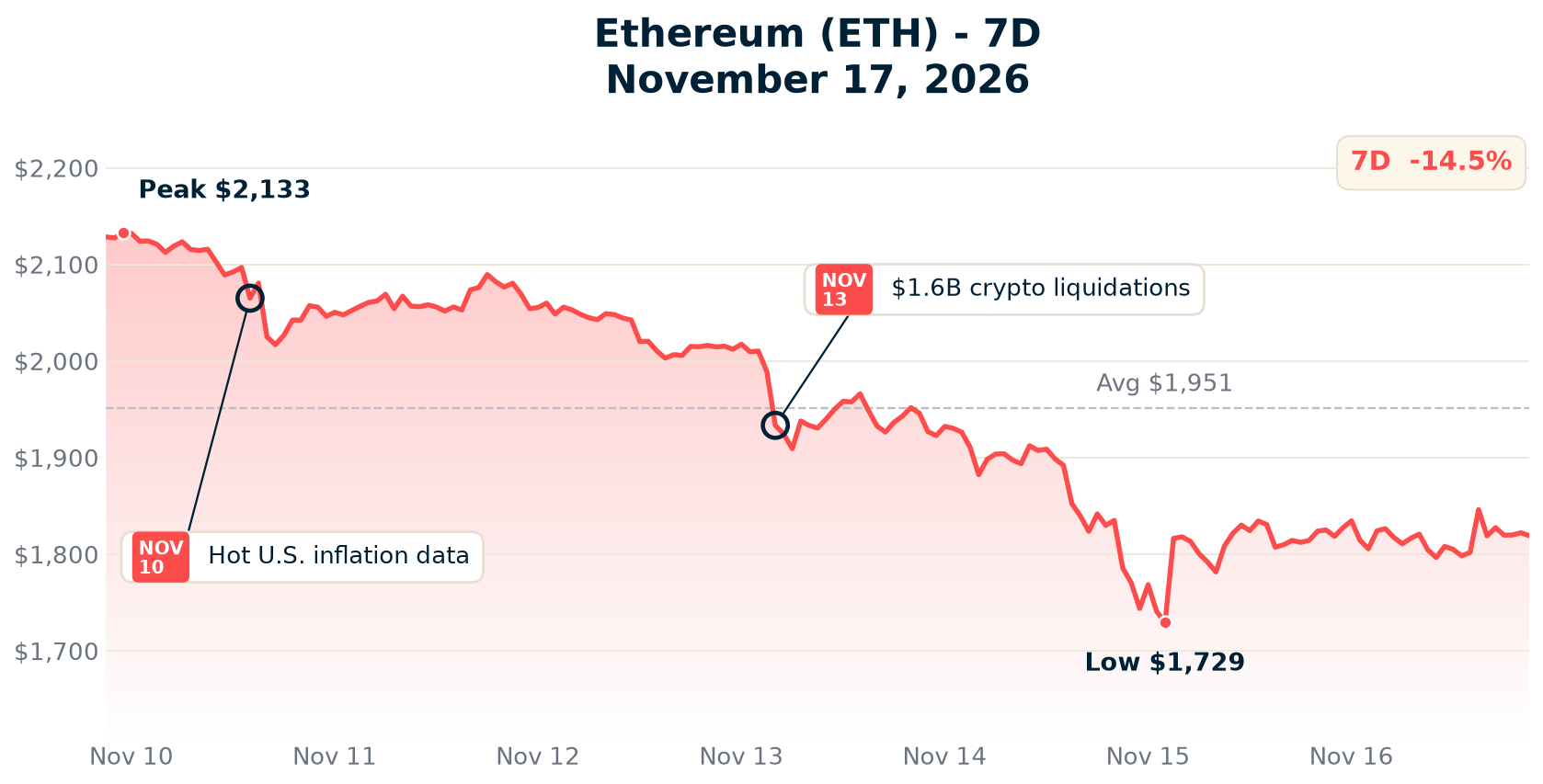
- Opened the week at US$2,128 and declined with the wider market to a weekly low of US$1,729 on Sunday, November 15. Ethereum is now trading around US$1,820 (-14.5% 7D).
- Ethereum dominance ranged between 9.9% and 10.4% this week.
- Ethereum-focused funds saw outflows of US$398.9 million, their seventh straight week of outflows.
Researchers at Ethlabs withdrew a proposal for faster block times from Hegotá, the Ethereum upgrade planned for 2027, and urged developers to add accounts that resist future quantum computers in the same year. The proposal had not been adopted, and any change still needs agreement from Ethereum's developers.
In Ethereum buying news:
- BitMine bought 7,653 ETH last week. The company now holds over 6 million ETH, worth about US$11.1 billion, or around 4.97% of supply. Over 5.2 million of BitMine's holdings are staked.
Past performance is not a reliable indicator of future results.
Altcoins
The altcoin season index is currently 44, which is near the midway point between bitcoin and altcoin season, though still weighted toward bitcoin season.
Ripple effect
- XRP declined by 12.8%. The token fell to US$0.89 over the weekend, its lowest level since November 2024, as money left crypto markets. U.S. XRP exchange-traded funds recorded their largest weekly outflow since March, though they have drawn about US$1.5 billion since launching in November 2025.
Out of beta
- Solana declined by 17.5%. The losses came despite the Solana Foundation retiring the network's "mainnet beta" label after more than six years and introducing Solana 1.0, a shared version number for its software. The change mainly affects how developers coordinate upgrades, and users' assets are unaffected.
HYPE fades
- Hyperliquid declined by 9.2%. The losses came despite news that the decentralised exchange's open interest rose almost 80% in the third quarter, passing Bybit, Kraken and OKX, according to a Hyperliquid-affiliated research group.
Lending a hand
- Jupiter declined by 3.3%. The losses came despite news that the Solana-based exchange aggregator added a market for Anchorage Digital Bank's USDGO stablecoin to its lending platform, Jupiter Lend, which has more than US$1 billion in active loans.
Crypto ETF News
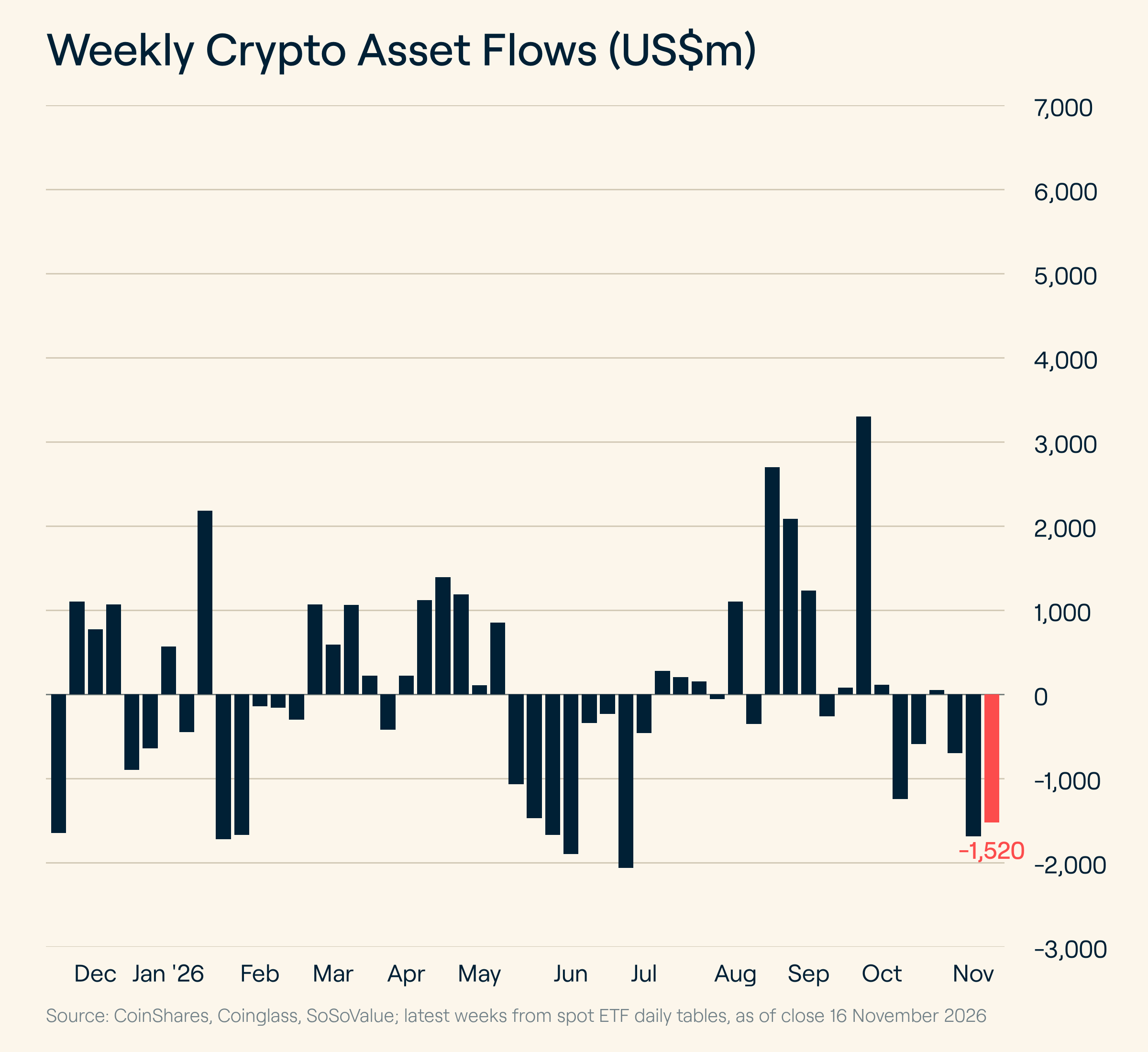
Digital asset investment products saw outflows of US$1.52 billion for the week, potentially reflecting weaker demand as expectations of a December U.S. rate hike held firm. Ethereum funds recorded their seventh straight week of outflows.
In altcoins, XRP, Solana and HYPE saw outflows of US$19.1 million, US$32.1 million and US$4.3 million, respectively.
JPMorgan's latest quarterly filing showed it held about US$540 million in BlackRock's iShares Bitcoin Trust at the end of September and had raised its Strategy stake by 36%. Trading firm Jane Street lifted its holding of Fidelity's bitcoin fund almost eightfold over the same quarter while trimming its stake in BlackRock's fund. The filings show positions at September 30, not current holdings.
Past performance is not a reliable indicator of future results.
Other crypto news
- The White House nominated four people to serve as commissioners at the U.S. Securities and Exchange Commission (SEC) and Commodity Futures Trading Commission (CFTC), its first picks for the agencies in about a year, two from each major party. Steven Levine would take Hester Peirce's seat at the SEC alongside fellow nominee Kristin Johnson, while Nathan Anonick and Matthew Rowland were named for the CFTC, which currently has only one sitting commissioner. The Senate Agriculture Committee is set to hold a hearing on the CFTC nominees on November 17, followed by a Senate Banking Committee hearing on the SEC nominees on November 19.
- The CLARITY Act remains stalled in the Senate, with no vote scheduled since a 49–50 procedural vote on September 15, and industry groups see little chance of market structure legislation passing before the new Congress starts in January. Democrats will then chair the committees that would handle any new bill.
- The U.S. Supreme Court declined to hear Custodia Bank's challenge over its bid for a Federal Reserve master account, leaving in place a ruling that the Fed has discretion over which eligible institutions get one. A master account gives a bank direct access to the Fed's payment systems, and the Wyoming-chartered, crypto-focused bank had sought one since 2020.
- The CFTC and the Department of Justice (DOJ) sued Arkansas and Louisiana to block state actions against prediction markets, after a Louisiana court granted a temporary restraining order against 31 companies, including Kalshi, Polymarket, Robinhood, Coinbase, Crypto.com and Gemini. A hearing in the Louisiana case is set for November 30.
- CFTC Chair Michael Selig announced the approval of an exchange and a clearinghouse for a firm that uses blockchain technology to trade and settle derivatives, calling it a regulated pathway for a new generation of market infrastructure. Such firms must meet the same standards as traditional exchanges and clearinghouses, including anti-money laundering, customer protection and segregation rules.
- The SEC filed a brief backing the CFTC in a legal fight with a group including Cboe and Citadel Securities over perpetual futures on U.S. stocks, which the CFTC allowed on November 2. Coinbase, Kraken parent Payward and Kalshi also back the CFTC.
- DBS and JPMorgan linked their blockchain-based deposit networks, so approved clients can move U.S. dollars between the two banks at any time, including weekends. The link connects DBS Token Services with JPMorgan's Kinexys, both permissioned blockchains open only to approved banks and clients, and feeds into Project BLOOM, led by the Monetary Authority of Singapore.
- The European Central Bank (ECB) warned that delays in EU legislation could push back the digital euro, and urged lawmakers to agree by the end of the year to keep a possible first issuance in 2029 on track. A 12-month pilot is planned from the second half of 2027.
Inside the Markets
Crypto fell harder than stocks in October as spot ETF demand reversed, AI stocks sold off and Binance suffered a record hack. Bitcoin closed the month down 7.3%.
We examine what drove October's sell-off, from the AI rout to the Binance hack, and the key catalysts for November.

from Caleb & Brown Cryptocurrency Brokerage.


