


Market highlights
- A U.S. House Committee advanced legislation establishing a Strategic Bitcoin Reserve.
- The CLARITY Act failed to advance in the U.S. Senate, in a 49–50 vote.
- The CFTC submitted a crypto markets prerule to the White House for review.
- U.S. SEC introduced "Innovation Exemption" allowing companies to trade tokenised stocks.
- The House Ways and Means Committee advanced the Digital Asset PARITY Act.
- The Digital Asset Tax Certainty Act will progress to a House markup vote this week.
Macro market overview
U.S. markets were mixed last week as investors digested the Federal Reserve's first rate hike in over three years, continued pressure in long-dated Treasuries and oil prices above US$100 a barrel. The Treasury's expanded bond-buyback program has provided little lasting relief since it repurchased US$5.19 billion of 10-to-20-year securities on September 10. The benchmark 10-year Treasury yield breached 5% during the week, while higher borrowing costs weighed particularly heavily on rate-sensitive stocks.
The Federal Reserve raised its benchmark interest rate by 25 basis points on Wednesday, taking the federal funds target range to 3.75%–4.00%. Chair Kevin Warsh said inflation had shown little improvement and the Fed indicated further tightening could be required. The announcement initially pushed the U.S. dollar higher and stocks lower, although equities rebounded strongly on Thursday as Treasury yields and oil prices eased. CME's FedWatch tool puts the likelihood of another rate increase at the Fed's October 28 meeting at 56.5%. Elsewhere, the Bank of Japan raised its policy rate to 1.25%, a 31-year high, while the Bank of England held at 3.75% in a 6–3 vote, with three members backing an immediate increase.
Middle East tensions continued to drive energy markets. Houthi attacks on Saudi infrastructure and the suspension of crude loadings at the Yanbu Red Sea export terminal pushed Brent to US$108.75 and WTI to US$105.83 on Tuesday. Prices subsequently retreated after Saudi Arabia moved additional crude through Oman and China, which pressed Iran to help restrain the Houthis. Shipping through the Strait of Hormuz remains severely restricted, with just four commodity vessels transiting on Thursday compared with a 10-day average of around 16.
Looking to the week ahead, markets will continue to monitor oil prices, Treasury yields and Middle East developments. The Swiss National Bank also delivers its next rate decision.
Weekly performance: S&P 500 -0.1%, Dow Jones -1.7%, Nasdaq +0.7%.
Looking ahead:
- Swiss National Bank rate decision - Thursday, September 24
- U.S. University of Michigan Consumer Sentiment - Friday, September 25
Crypto Market Performance
Market Cap: $2.94T (+5.6% 7D)
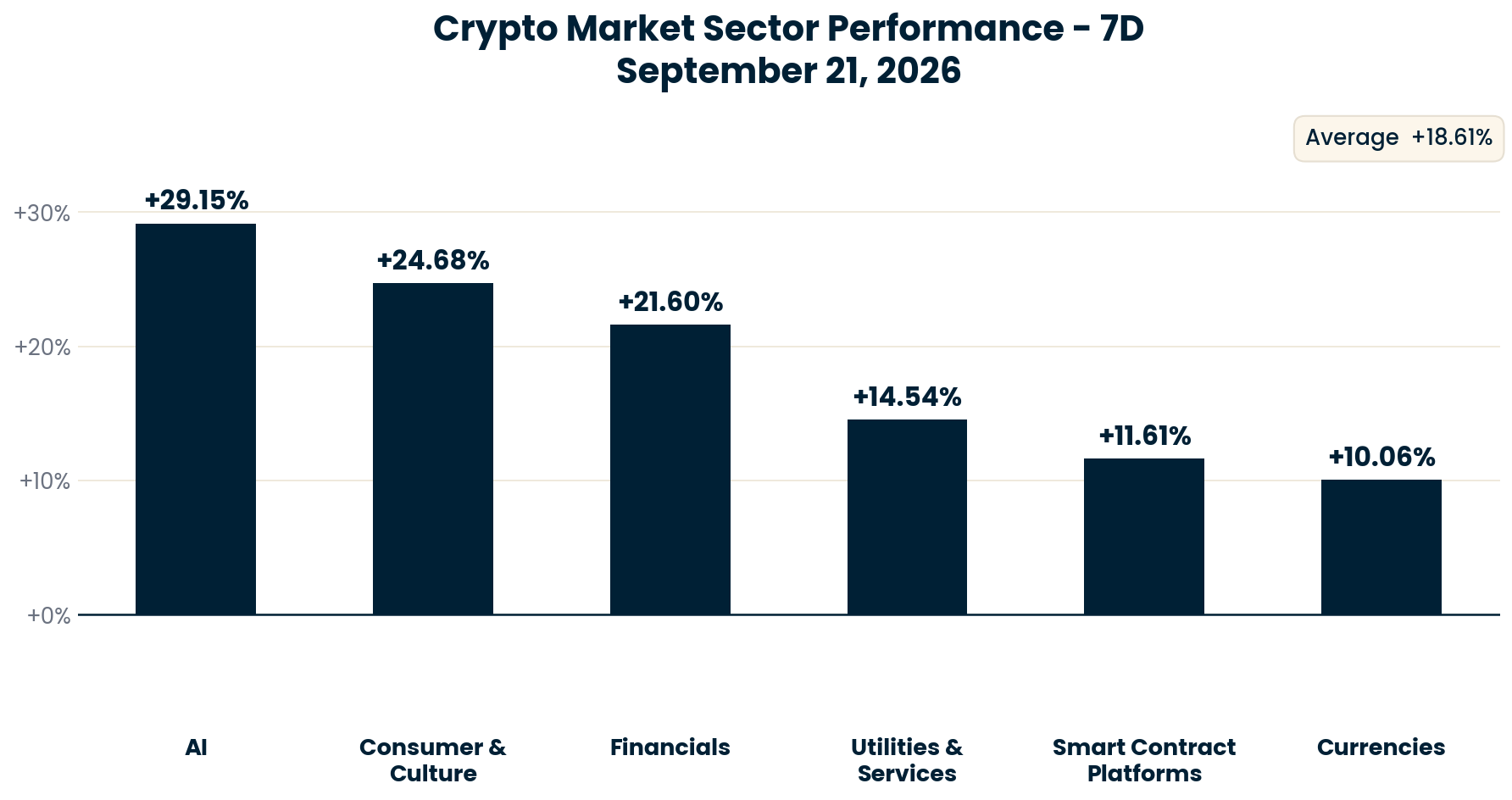
All crypto sectors saw sizeable gains, as the Fed's rate hike, CLARITY Act failure and several regulatory developments across crypto moved markets. AI led with a 29.2% gain, followed by consumer and culture at 24.7%, while currencies lagged at 10.1%. As bitcoin broke above US$86,000, in its strongest rally in over three months, almost US$650 million in crypto shorts were liquidated. The crypto fear and greed index is in "extreme greed" at 80.
Past performance is not a reliable indicator of future results.
Bitcoin (BTC)
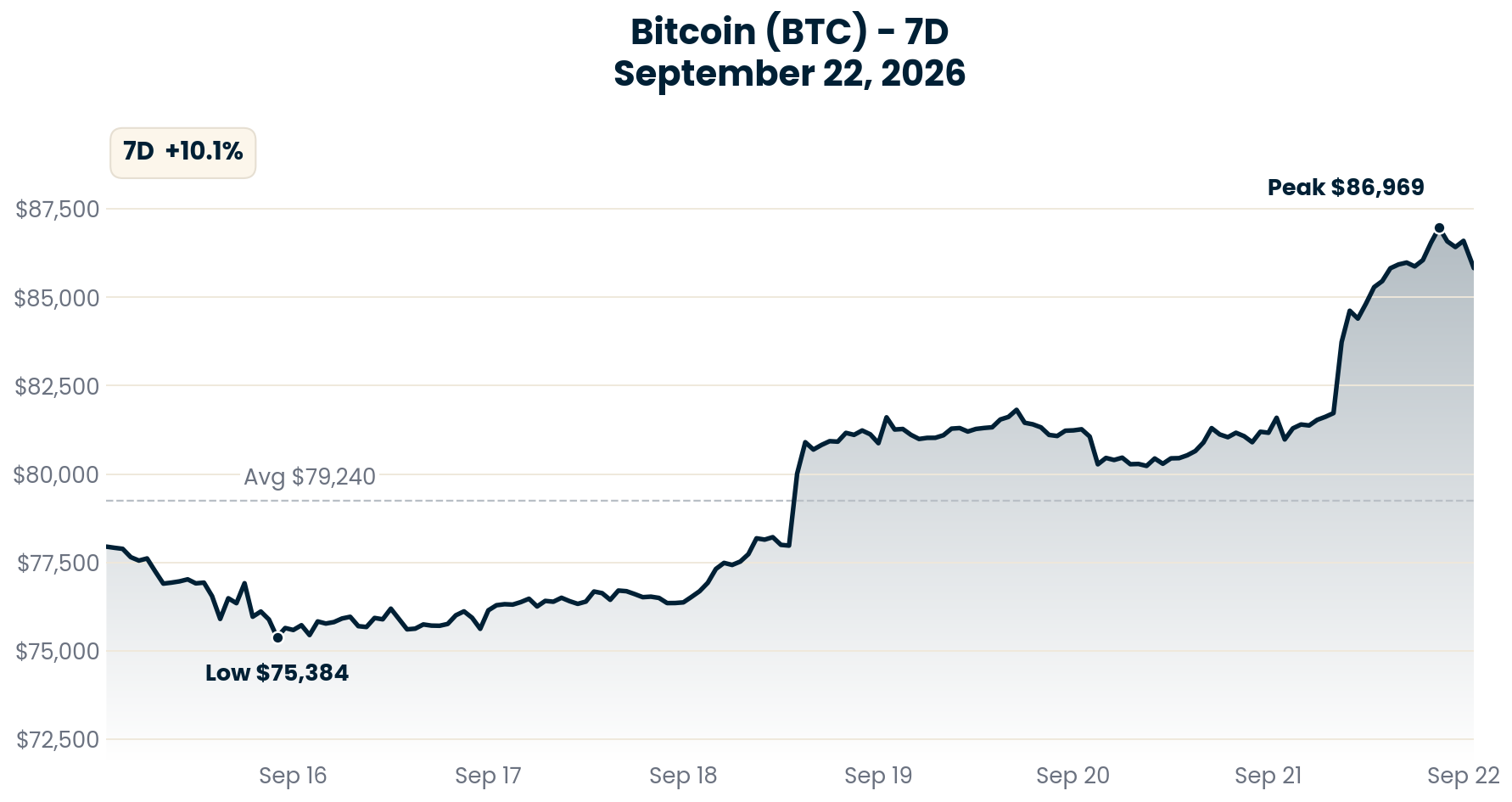
- Opened the week at US$76,804, declined on the Fed's rate hike, then gained to a weekly high of US$81,914 on a short squeeze, the U.S. federal bitcoin reserve bill passing a House committee vote, and the U.S. Securities and Exchange Commission's (SEC) five-year tokenised stock exemption. Bitcoin gained into the new week, and is now trading around US$86,650 (+10.1%).
- BTC dominance ranged between 59% and 59.5% this week.
- Bitcoin investment products saw inflows of US$68.1 million.
The U.S. House Financial Services Committee advanced legislation establishing a Strategic Bitcoin Reserve, voting 28–21 along party lines. The revised bill removes proposed Federal Reserve and gold-based funding mechanisms and reduces reporting requirements. Government-held bitcoin would be locked for 20 years, while future purchases would require a taxpayer-neutral funding method.
Bitcoin Core 32.0 entered final testing ahead of a targeted October 10 release. The update accelerates some block verification by reading database information in parallel, adopts a newer partially signed transaction format for several wallet commands, and patches security vulnerabilities involving malicious wallet names and excessive memory consumption in its HTTP server.
In bitcoin buying news:
- Strategy bought 950 bitcoin (US$76 million), bringing its holdings to 846,000 BTC (over US$70 billion) at an average purchase price of US$75,416 per bitcoin.
Past performance is not a reliable indicator of future results.
Ethereum (ETH)
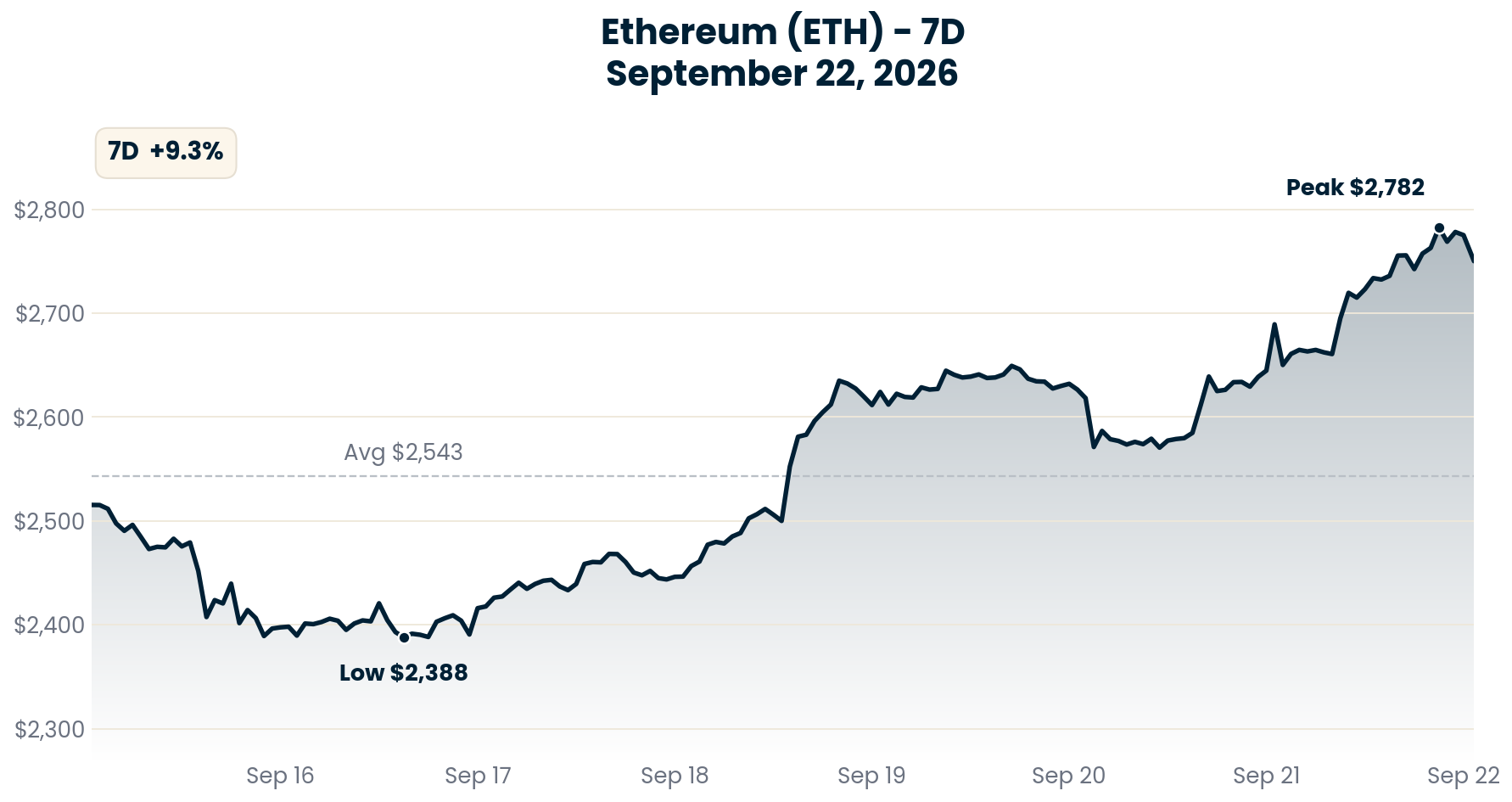
- Opened the week at US$2,476, declined to a low of US$2,356 on Tuesday, September 15 and rallied into the end of the week as crypto sentiment strengthened. The upward momentum continued into the new week, with Ethereum now trading around US$2,770 (+9% 7D).
- Ethereum dominance ranged between 11.4% and 11.8% this week.
- Ethereum-focused funds saw outflows of US$140.9 million.
Vitalik Buterin argues AI could strengthen rather than undermine crypto security by making formal verification of complex software practical. Developers are already using AI to find vulnerabilities across Ethereum and bitcoin projects. Buterin says mathematically verifying entire programs will be essential for secure, scalable and privacy-focused blockchains.
In Ethereum buying news:
- BitMine bought 27,562 ETH (US$75.2 million). The company now holds almost 6 million ETH, worth US$17.1 billion, or around 4.9% of supply.
Past performance is not a reliable indicator of future results.
Altcoins
The altcoin season index is currently 48, which is near the midway point between bitcoin and altcoin season.
ETH ecosystem strength
- Arbitrum gained 66.2%. The layer-2 scaling chain for Ethereum continued its upward momentum from increased revenue from Robin Hood chain and strong market interest in layer-2 ETH networks.
- Ethena gained 45.5%. The DeFi protocol, which issues the synthetic USDe on the Ethereum network saw momentum as market interest in layer-2 networks remained strong. It follows the recent launch of Ethena Pay, a self-custodial neobanking app on Avalanche offering USDe savings, global transfers and Visa spending.
Back to the perpetual futures
- Near Protocol gained 66.1%. The fully sharded, quantum adaptive layer-1 chain broke a months-long downtrend after launching confidential perpetual futures powered by Hyperliquid. The privacy-focused product masks traders' positions, while growing interest in NEAR's cross-chain Intents and AI infrastructure also supported the rally.
Avalanche x PAXOS
- Avalanche gained 47.4%. The layer-1 chain rallied after Paxos added AVAX and Avalanche-based USDC, expanding access across its institutional network. The September 22 Helicon upgrade will also cut minimum staking lock-ups from two weeks to 48 hours, potentially boosting staking demand and investor flexibility.
AI gains
- Venice Token gained 46.8%. The native utility and governance token for Venice AI saw continued upward momentum following last week's burn of 16,563 VVV, reinforcing the network's deflationary tokenomics.
Need for speed
- Solana gained 15.8%. The layer-1 network rallied due to an upgrade, which saw its target slot time fall from 300 to 250 milliseconds, making blocks arrive nearly 17% faster. The upgrade improves transaction freshness rather than network capacity, benefiting applications such as oracles and automated market makers. A final reduction to 200 milliseconds is planned if validator block-skip rates remain stable.
Crypto ETF News
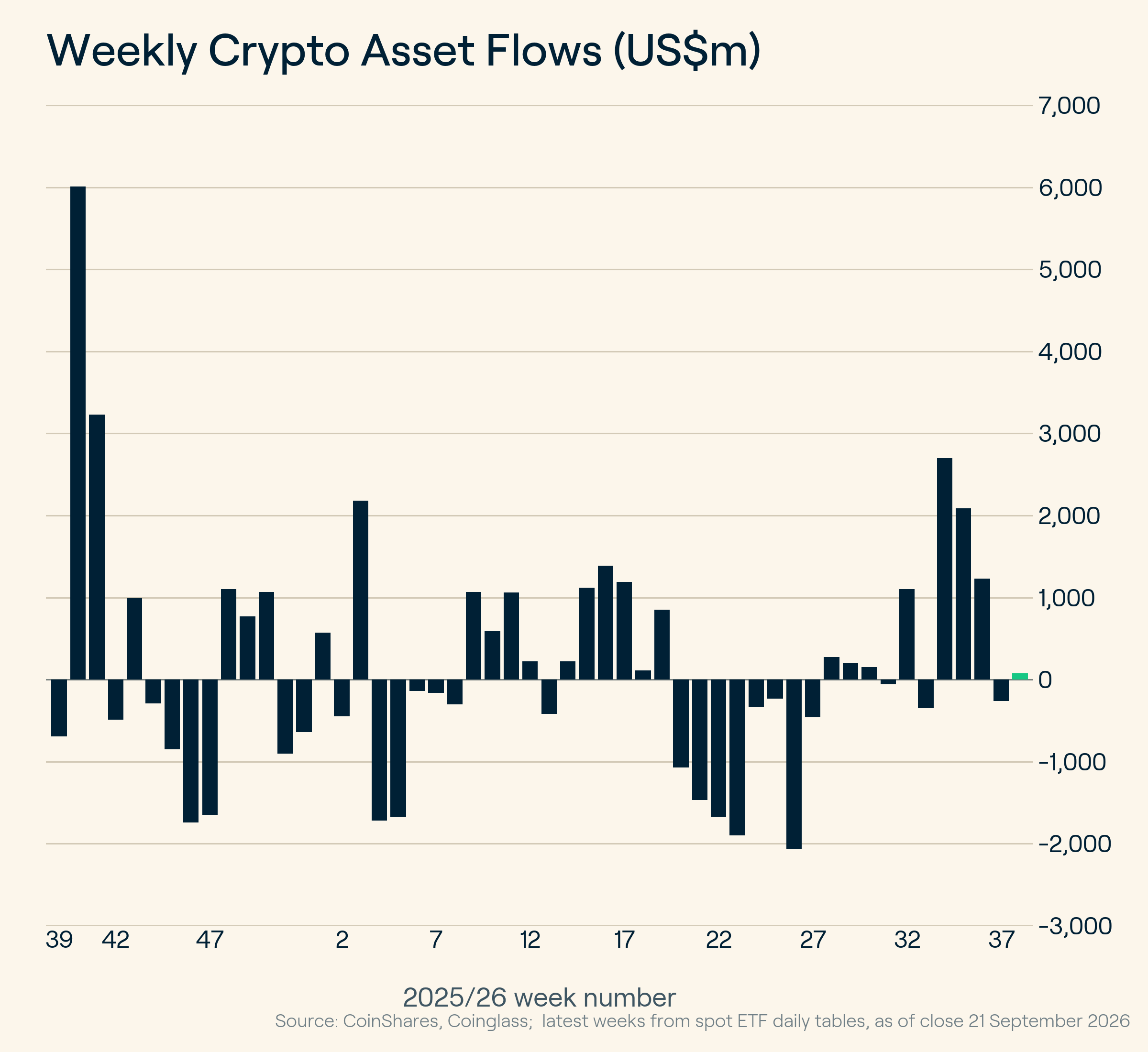
Digital asset investment products saw inflows of US$77.7 million for the week as the Fed's interest rate rise, the CLARITY Act's failure in the Senate and geopolitical uncertainty rattled markets throughout the first half of the week. Bitcoin's short squeeze and the SEC's five-year exemption on tokenised stocks saw sentiment improve throughout the week's end and into the new week.
In altcoins, XRP, Solana and HYPE saw inflows of US$9.6 million, US$69.1 million and US$3.8 million, respectively.
Past performance is not a reliable indicator of future results.
Other crypto news
- The CLARITY Act failed to advance in the U.S. Senate, falling short of the 60 votes required for cloture in a 49–50 vote. Disputes remained over crypto ethics rules, stablecoin rewards and developer protections. The setback shifts regulatory attention for crypto toward the U.S. SEC and Commodity Futures Trading Commission (CFTC), although senators could attempt to revive the CLARITY Act.
- The Commodity Futures Trading Commission (CFTC) submitted a crypto markets prerule to the White House for review, signalling plans to regulate digital asset derivatives using existing authority after the CLARITY Act failed to clear a Senate cloture vote. The agency also issued no-action relief allowing passive crypto software providers, including wallets and trading apps, to connect users directly to regulated derivatives markets without registering as introducing brokers.
- The U.S. SEC introduced a five-year "Innovation Exemption" allowing qualifying venues to trade tokenised U.S. stocks through blockchain-based automated market makers without registering as national exchanges. Eligible tokens must provide full shareholder rights, while synthetic stocks are excluded and companies can block tokenisation of their shares.
- The House Ways and Means Committee advanced the Digital Asset PARITY Act, which would clarify U.S. crypto tax treatment. The bill proposes exemptions for small stablecoin transactions, defers taxes on staking rewards until sale, and extends securities-style rules to crypto lending. It now advances to the full House for a floor vote.
- The Digital Asset Tax Certainty Act will progress to a House markup vote this week. The act would exempt qualifying crypto transaction fees of US$10 or less from capital gains calculations beginning in 2028. It also introduces rules covering stablecoins, staking, mining, lending and wash sales. The proposal requires approval from both chambers of Congress and the president before becoming law.
- Circle launched Arc, its layer-1 blockchain for payments, trading and agentic commerce, with more than 100 partners. Founding validators include BlackRock, DTCC, Mastercard and Visa. USDC serves as gas. Circle also minted 10 billion ARC tokens, though it has not committed to a public token launch.
- The UK Financial Conduct Authority issued guidance ahead of its September 30 crypto authorisation window, outlining which activities require approval under rules commencing October 2027. Overseas firms serving UK retail customers must also obtain authorisation. Applications submitted by February 28, 2027 will receive transitional protection.
- The European Central Bank (ECB) plans to invest a small portion of its own funds in tokenised euro-denominated public-sector securities. Transactions will settle in central bank money through its new Pontes service, giving the ECB practical experience with distributed-ledger technology across trading, settlement and portfolio management. No investment amount or launch date was disclosed.
- S&P Global agreed to acquire smart-contract security firm OpenZeppelin, whose code libraries underpin more than US$37 trillion in stablecoin, tokenised-fund and DeFi transfers. OpenZeppelin will remain a separate business unit, helping S&P develop security assessments, benchmarks and data services for the technical risks underlying increasingly institutional on-chain financial products.
- DeFi Development Corp added 55,491 SOL worth almost US$5.8 million, lifting its treasury to roughly 2.39 million SOL. The Nasdaq-listed company also launched a US$300 million at-the-market program for CHAD preferred shares, with proceeds primarily intended to fund further SOL purchases without diluting common shareholders.
- The U.S. Treasury sanctioned Iranian crypto exchange BitBank, alleging it processed bitcoin payments collected from ships for safe passage through the Strait of Hormuz. Similarly, U.S. prosecutors are seeking forfeiture of US$61 million in cryptocurrency allegedly linked to black-market Iranian oil sales. Two Chinese companies allegedly used Binance accounts to launder proceeds benefiting Iran's government and military. A related wallet network handled more than US$1.5 billion, though the allegations remain unproven.
from Caleb & Brown Cryptocurrency Brokerage.


