


Market highlights
- Senate releases new CLARITY Act wording ahead of September 15 procedural vote.
- Blockstream refuses to pay ransom for 598.5 BTC withheld after the Liquid Network exploit.
- Vitalik Buterin backing EIP-8288, which could cut quantum-safe transaction costs by 99%.
- Block applied for an Office of the Comptroller of the Currency national trust bank charter.
- Visa combining settlement data and blockchain lending so stablecoin card programs grow.
- Bitwise to close its Dogecoin ETF BWOW on October 14.
Macro market overview
U.S. markets ended lower after a volatile holiday-shortened week, as renewed inflation concerns, surging oil prices and rising Treasury yields outweighed Friday's rebound in equities. The U.S. Treasury followed through on its effort to support longer-dated debt, announcing on Wednesday that it would buy up to US$6 billion of Treasuries maturing in 10 to 20 years, triple its previous US$2 billion ceiling. Treasury ultimately repurchased US$5.19 billion on Thursday, September 10. The move failed to reassure bond investors: the 10-year yield briefly reached 4.99%, its highest level in almost three years, while 30-year yields climbed to 19-year highs as markets remained concerned about inflation, widening fiscal deficits and the sustainability of U.S. debt.
Inflation data further strengthened expectations of a September Federal Reserve rate hike. The August producer price index rose 0.4% month-on-month and 5.4% year-on-year, driven partly by a 4.2% increase in energy prices. Meanwhile, the consumer price index (CPI) increased 0.4% in August and remained at 3.4% annually, while core CPI rose a stronger-than-expected 0.3%. Following Friday's CPI release, CME's FedWatch tool puts the likelihood of a rate hike at the Fed's September 16 meeting at around 86%, up from roughly 56% at the start of the month. Also this week, the European Central Bank lifted its main refinancing rate to 2.65%.
Middle East developments were another major driver of market movements. Brent crude moved above US$100 a barrel as U.S.-Iran hostilities intensified and Iran-backed Houthis attacked Saudi energy infrastructure. Restricted shipping through the Strait of Hormuz and disruptions around the Red Sea pushed Brent as high as US$109.97 on Thursday before it retreated to settle at US$104.61 on Friday, still roughly 9% higher for the week.
Looking ahead, attention will centre on the Federal Reserve's September 15-16 meeting, further movements in Treasury yields and oil prices, and any progress toward restoring shipping through the Strait of Hormuz.
Weekly performance: S&P 500 -0.8%, Dow Jones -1.6%, Nasdaq -0.7%.
Looking ahead:
- U.S. Federal Reserve rate decision - Wednesday, September 16
- Bank of England rate decision - Thursday, September 17
- Bank of Japan rate decision - Friday, September 18
Crypto Market Performance
Market Cap: $2.68T (-1.1% 7D)
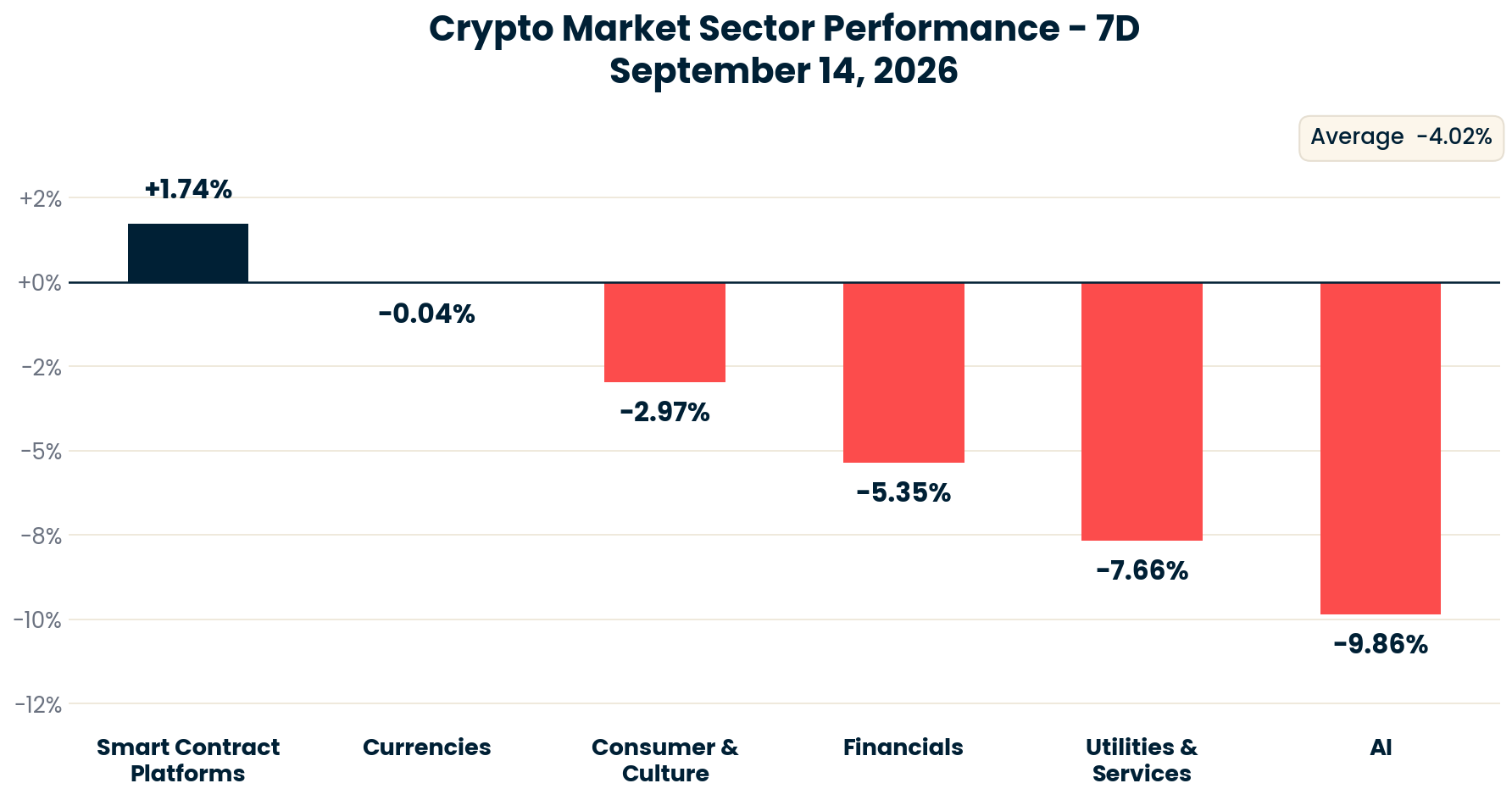
Most crypto sectors saw declines this week as risk assets wavered on growing expectations of a Fed rate hike on September 16. All sectors saw declines, with the exception of smart contract platforms, which made minor gains. The crypto fear and greed index remains in "greed" at 69.
Past performance is not a reliable indicator of future results.
Bitcoin (BTC)
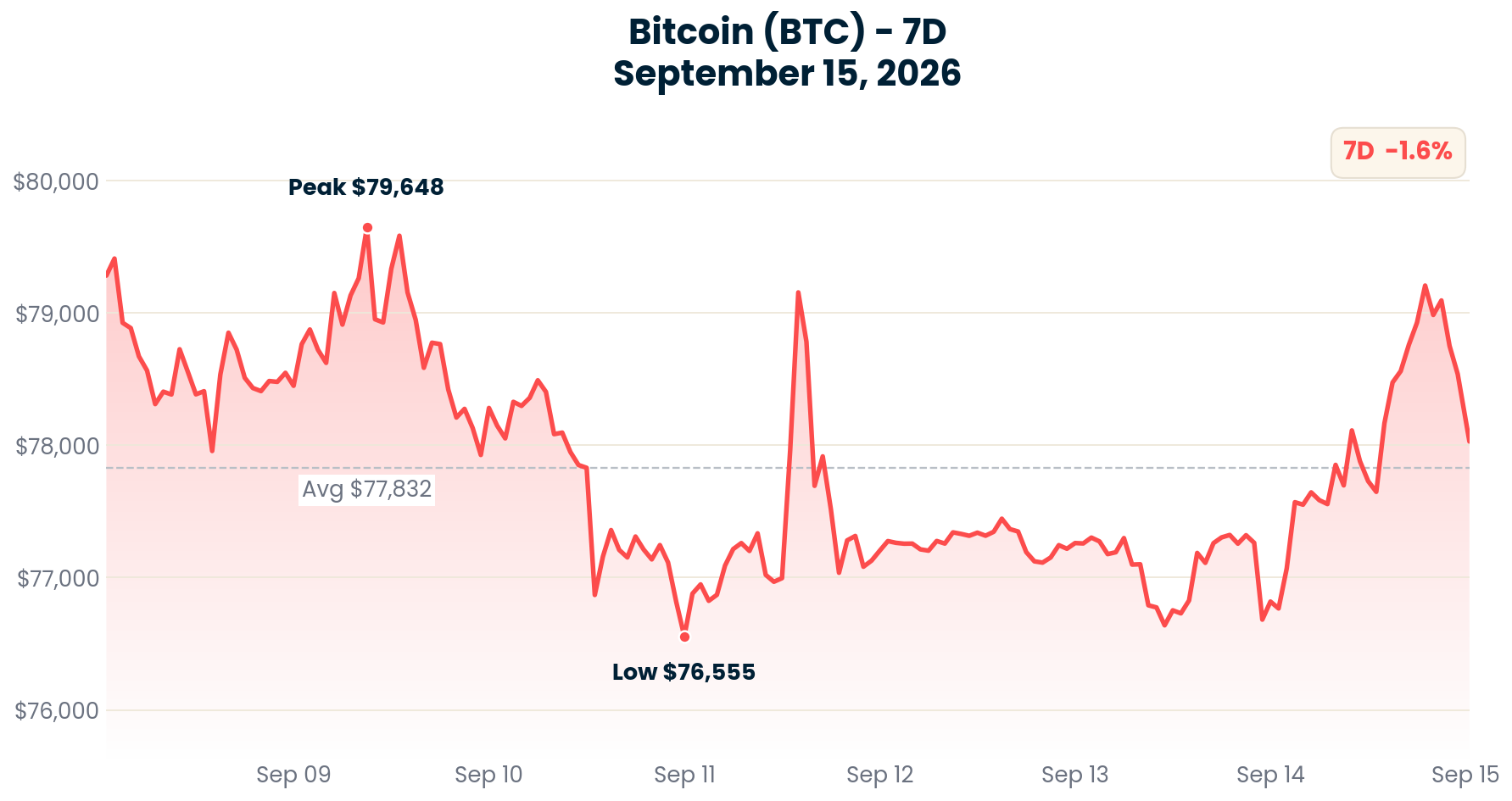
- Opened the week at US$79,284 and declined, presumably due to uncertainty around U.S. debt, inflation and Middle East tensions raising the likelihood of a rate hike from the U.S. Federal Reserve. Bitcoin gained into the new week and is now trading around US$78,030 (-1.6% 7D).
- BTC dominance ranged between 59.7% and 59% this week.
- Bitcoin investment products saw outflows of US$462.7 million.
Blockstream refused to pay a ransom for 598.5 BTC, worth US$47 million, still withheld after the Liquid Network exploit. Attackers returned 3,400 of roughly 4,000 stolen BTC but demanded a 10% bounty. Blockstream called the incident theft and plans to pursue recovery through law enforcement and forensic specialists.
In bitcoin buying (and selling) news:
- Strive bought a further 469 bitcoin for US$36.6 million at an average US$77,954, taking its treasury to exactly 25,000 BTC and making it the fifth-largest listed bitcoin holder. The entire purchase was funded through its SATA perpetual preferred stock, without issuing common shares.
- Strategy doubled its digital credit securities repurchase authorisation to US$2 billion and repurchased approximately US$139.3 million of STRC preferred shares between September 8 and 13. The company neither bought nor sold bitcoin, holding 845,050 BTC for a second consecutive week.
Past performance is not a reliable indicator of future results.
Ethereum (ETH)
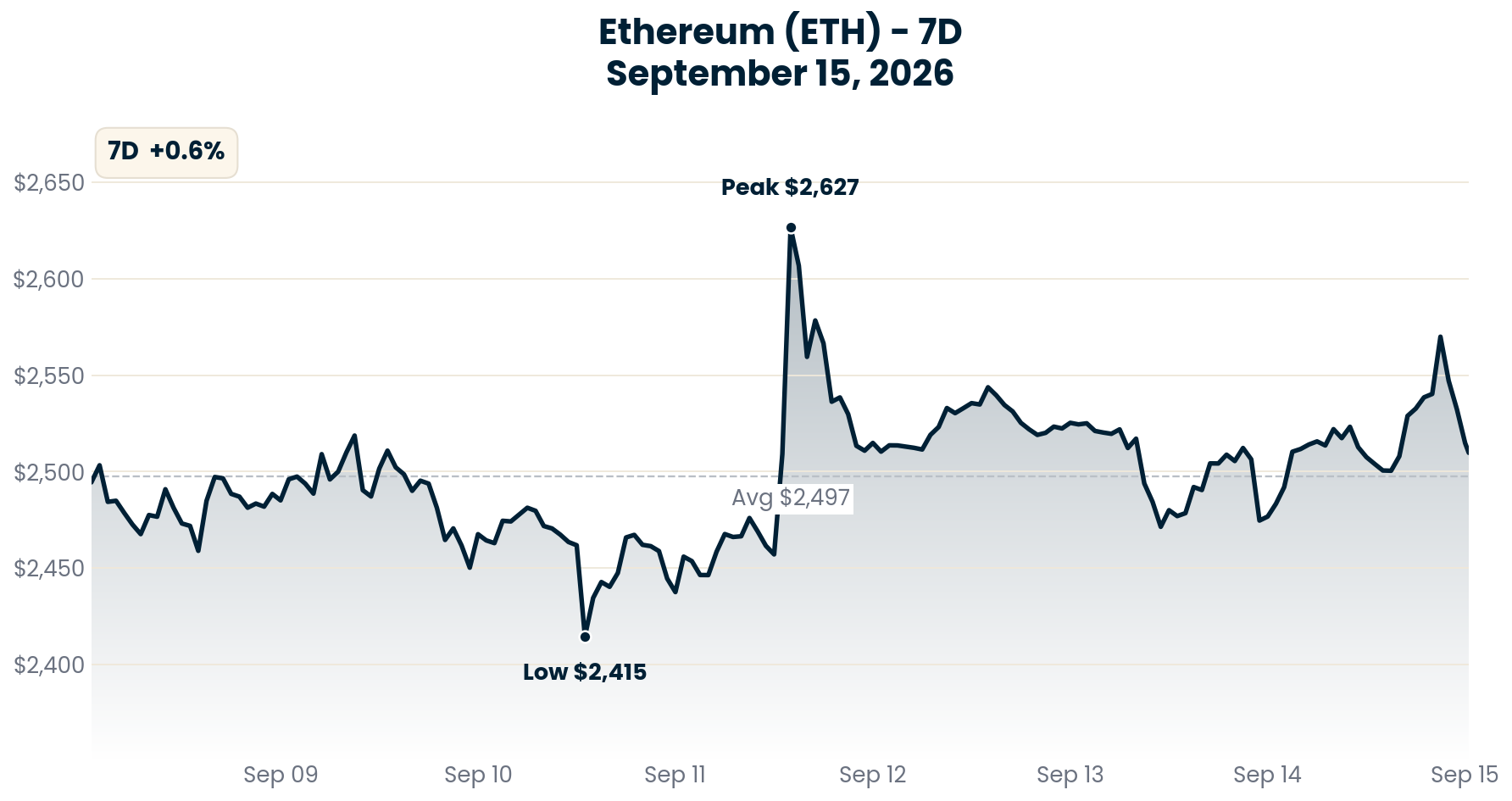
- Opened the week at US$2,494, declined to a low of US$2,415 on Thursday, September 10 and gained momentum throughout the end of the week on a 14% rise in transactions over US$1 million, indicating potential growth in whale activity and liquidating US$250 million of ETH shorts in the process. Ethereum gained into the new week, and is now trading around US$2,510 (+0.6% 7D).
- Ethereum dominance ranged between 11.4% and 12% this week.
- Ethereum-focused funds saw inflows of US$196.9 million.
Vitalik Buterin is backing EIP-8288, which could cut Ethereum's quantum-safe private transaction costs by more than 99%, from roughly 10 million gas to tens of thousands. The proposal bundles quantum-resistant signatures and STARK proofs into one proof per block and could establish RISC-V as Ethereum's canonical instruction set.
Ethereum proposal EIP-8141 would let users pay gas fees with ERC-20 tokens or have applications sponsor fees without switching to smart accounts. Its "Frames" architecture separates transaction validation, payment and execution, enables batched actions and key rotation, and could help Ethereum transition away from cryptography vulnerable to future quantum computers.
In Ethereum buying news:
- BitMine bought 27,180 ETH (US$68 million). The company now holds almost 6 million ETH, worth US$15 billion, or around 4.9% of supply.
Past performance is not a reliable indicator of future results.
Altcoins
The altcoin season index is currently 37, which is near the midway point between bitcoin and altcoin season, though still weighted toward bitcoin season.
Venice is burning
- Venice Token gained 24.9%. The native utility and governance token for Venice AI made gains after its largest discretionary burn of 16,563 VVV and planned emission cuts tightened supply. Rising Venice AI revenue, AI-privacy demand and heavy trading amplified gains.
RAY of sunshine
- Raydium gained 19.8%. The automated market maker and decentralised exchange on the Solana blockchain saw upward momentum as daily trading volume reached US$173.8 million, equivalent to 77% of its market cap. The rally reflected increased Solana DEX activity and speculative trading, despite no major protocol upgrade or partnership announcement.
Cronos exploit
- Cronos gained 4.5%. Cronos detailed how validators rolled back 10,961 blocks, erasing nearly two hours of transactions to reverse US$111.2 million from a Tectonic lending exploit. The attacker manipulated TONIC's price before borrowing US$120.4 million against inflated collateral. Around US$9.19 million escaped the network and remains unrecovered, while legitimate transactions were also reversed.
Crypto ETF News
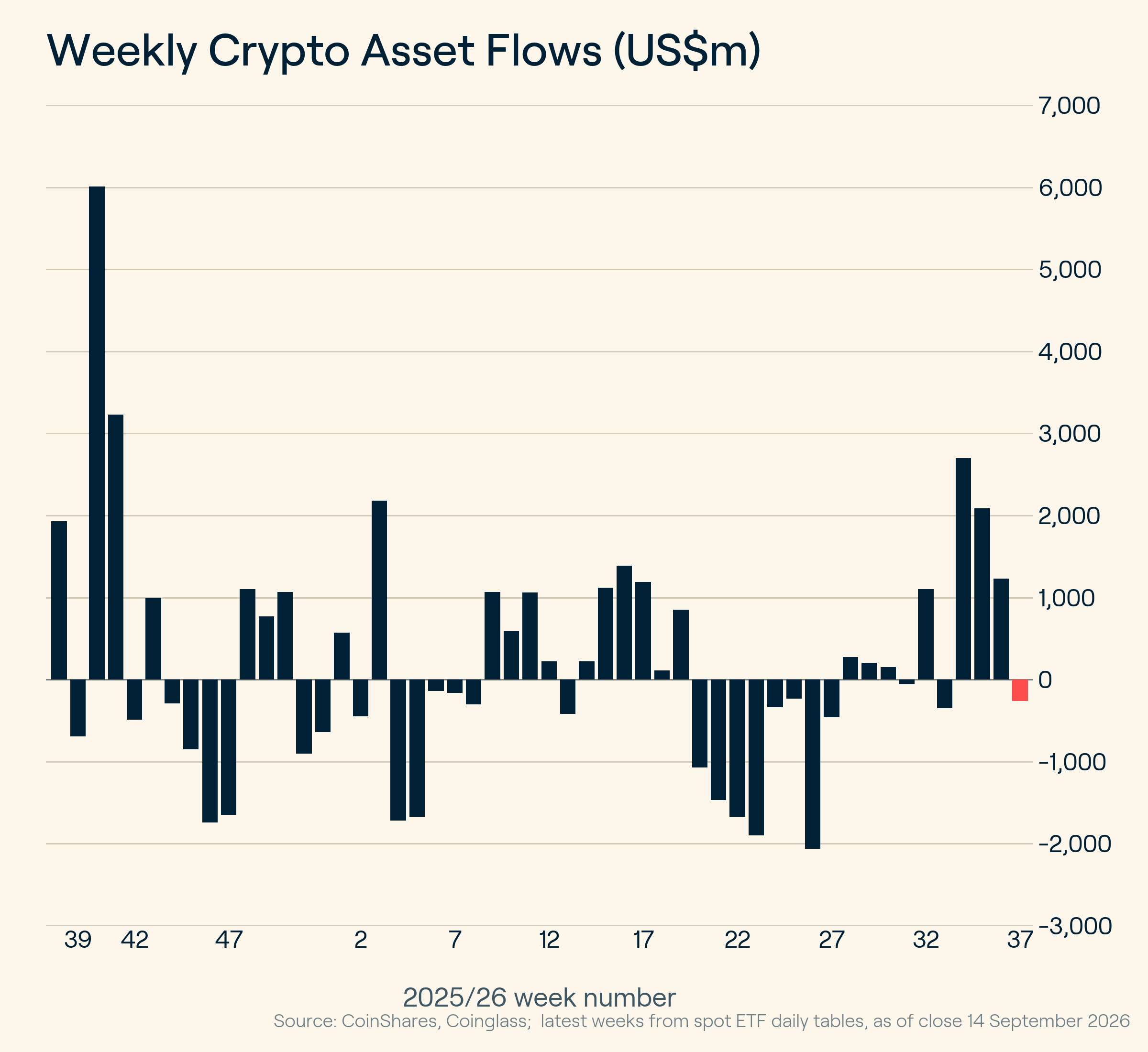
Digital asset investment products saw outflows of US$263.6 million for the week on renewed interest rate uncertainty.
In altcoins, XRP and Solana saw inflows of US$19 million and US$9.7 million, respectively. HYPE saw outflows of US$26.5 million.
Bitwise will close its Dogecoin exchange-traded fund (ETF), BWOW, less than a year after launch. The fund held just US$722,000 in assets. Trading ends October 14, with remaining shareholders receiving cash.
Past performance is not a reliable indicator of future results.
Other crypto news
- Senate Republicans released a revised CLARITY Act requiring crypto trading protocols controlled by people or groups to register with the Commodity Futures Trading Commission. The 635-page final text incorporates 126 changes requested by Democrats and strengthens the bill's ethics provisions. President Trump has accepted the tougher terms. Officials and their spouses must now divest crypto holdings or move them into a blind trust, state attorneys general can sue to enforce the rules, and the provision no longer expires in 2029. Democrats remain largely opposed, and the September 15 procedural vote needs 60 votes — meaning at least seven would have to cross.
- Visa is combining VisaNet settlement data with blockchain lending to help stablecoin-linked card programs access working capital. Its Credit Coop model uses smart contracts to automate funding and repayment and has financed more than US$2.5 billion since 2023 without defaults. Visa's stablecoin settlement volume now exceeds a US$20 billion annualised rate.
- Circle agreed to acquire Singapore-based cross-border payments platform Tazapay for US$400 million in stock, extending USDC payment rails into more than 100 payout markets. Tazapay brings over US$25 billion in annualised payment volume and 60-plus banking and fintech partners, with around 60% of its transaction volume already involving stablecoins. The deal is expected to close in 2027, subject to regulatory approvals including from the Monetary Authority of Singapore.
- PayPal, alongside M0 and MoonPay, launched PYUSDx, a platform letting any business issue its own custom stablecoin backed one-for-one by PayPal USD. Saturn, Concrete and Cap went live first and have together processed more than US$100 million. The move turns PYUSD from a payment token into a reserve asset underpinning application-specific tokens, though those tokens are not PayPal products and cannot be held in PayPal or Venmo wallets.
- Tether and London private credit manager Fasanara launched StableFund, anchored by US$400 million of co-investment and targeting up to US$3 billion more from institutions. Fasanara will deploy the capital as short-term asset-backed loans through fintech lenders in more than 60 countries, while Tether sources USDT-linked financing and provides settlement infrastructure, aimed at a small-business financing gap it puts at US$5.7 trillion.
- Block applied for an Office of the Comptroller of the Currency national trust bank charter for Builders Bank & Trust, which would custody bitcoin and other digital assets, execute customer trades and settle stablecoins. The uninsured, non-depository bank would consolidate crypto services currently operating under more than 50 state licences into a single federal regulatory framework.
- Germany's Finance Ministry proposed a 25% flat tax on crypto gains from 2027, eliminating the current exemption for assets held over 12 months. The change would apply only to crypto purchased from January 2027. Staking and lending income would also be taxed as capital income, with automatic withholding beginning in 2028.
- The U.S. Secret Service froze US$52.8 million in USDT across 52 wallets linked to Xinbi Guarantee, a Telegram marketplace that sells tools to scammers and processed at least US$24 billion since 2022. The Treasury also sanctioned Xinbi as a transnational criminal organisation, prompting the marketplace to begin shifting funds from freezeable USDT into USDD.
- Hackers breached Trezor's third-party email provider and sent phishing messages from its legitimate domain. The emails falsely claimed a hardware vulnerability threatened recovery phrases and directed users to a malicious link. Trezor took the domain offline and investigated, while similar attacks targeting BitBox users suggested a broader provider compromise.
- India launched "Demat 2.0," a pilot tokenising corporate bonds within its US$620 billion market. Three issuers have already raised roughly US$107 million. The system uses a permissioned blockchain and India's wholesale digital rupee to enable instant settlement, while smart contracts automate interest payments and redemptions. Retail access is planned.
- Nasdaq Ventures invested US$100 million in Payward, valuing it at US$21 billion. The deal expands their tokenised-equities partnership, with Kraken set to distribute Nasdaq-listed stocks carrying traditional shareholder voting rights. Payward will also adopt Nasdaq's market-surveillance technology as both companies develop infrastructure connecting regulated and on-chain markets.
Inside the Markets
August delivered a decisive turn in crypto. Bitcoin gained 25% and Ethereum 33% as the U.S. Treasury doubled its buybacks of long-dated bonds, pushing yields off their highs and drawing roughly US$2.5 billion into U.S. spot bitcoin ETFs over seven trading sessions — the strongest stretch since October 2025. Gold rose 9.7% and silver around 15% as the same debasement concerns lifted hard assets alongside crypto.
In this month's Inside the Markets, we examine what drove the rally, Strategy's reversal from seller to buyer, and the catalysts shaping September — from the Fed's September 16 decision and the Treasury's expanded buyback window through to global liquidity and oil flows through the Strait of Hormuz.
from Caleb & Brown Cryptocurrency Brokerage.


