


Market highlights
- U.S. Treasury proposed GENIUS Act rules requiring stablecoin issuers to be licensed from 2027.
- SharpLink will stake US$200 million worth of Ethereum, allowing it to earn staking rewards.
- Goldman Sachs to acquire NEOS Investments, gaining roughly US$30 billion in ETFs.
- Fidelity filed to allow its spot Ethereum ETF, FETH, to stake up to 100% of its ETH holdings.
- U.S. SEC cancels meeting where the agency was due to consider crypto-specific rules.
- Trump Media & Technology Group reported a US$238 million second-quarter loss.
Macro market overview
The S&P 500 closed at its 27th all-time high of the year this week, ending Thursday, August 13 above 7,800. The continued gains across the S&P 500 and Nasdaq came as the U.S. consumer price index came in at 3.4% for the 12 months ending July 30, while the annual producer price index decelerated from 5.5% to 4.7% over the same period. The cool inflation readings have reduced the probability of a September rate hike. CME Group's FedWatch tool puts the likelihood of rates staying on hold at 65%, an increase of over 15% from last week.
While the S&P 500 and Nasdaq ended the week with minor gains, the Dow Jones declined, presumably due to July's retail sales making a 0.6% decline, compared to a forecast increase of 0.1%. Friday's session saw risk assets decline as macro headwinds, including Middle East tensions, soft U.S. retail sales data, and a below-forecast University of Michigan preliminary consumer sentiment survey (51 vs 54.7), suggested signs of a cooling economy.
In geopolitics, tensions between the U.S. and Iran continue. The memorandum of understanding between the two nations expired on Monday, August 17 as the country's leaders threaten to re-escalate tensions. Oil prices increased by almost 4% on the week, with West Texas Intermediate closing the week at almost US$82.
This week, market participants will presumably be monitoring developments in the Middle East, the U.S. Federal Open Market Committee's (FOMC) July meeting minutes, flash manufacturing and services purchasing managers index (PMI) data from Europe and the U.K., and second-quarter earnings from major U.S. retailers, including Home Depot, Target, Walmart, and Lowes.
Weekly performance: S&P 500 +0.4%, Dow Jones -0.6%, Nasdaq +0.1%.
Looking ahead:
- U.S. FOMC meeting minutes - Wednesday, August 19
- Flash manufacturing and services PMI (France, Germany, and U.K.) - Friday, August 21
Crypto Market Performance
Market Cap: $2.2T (+1.8%)
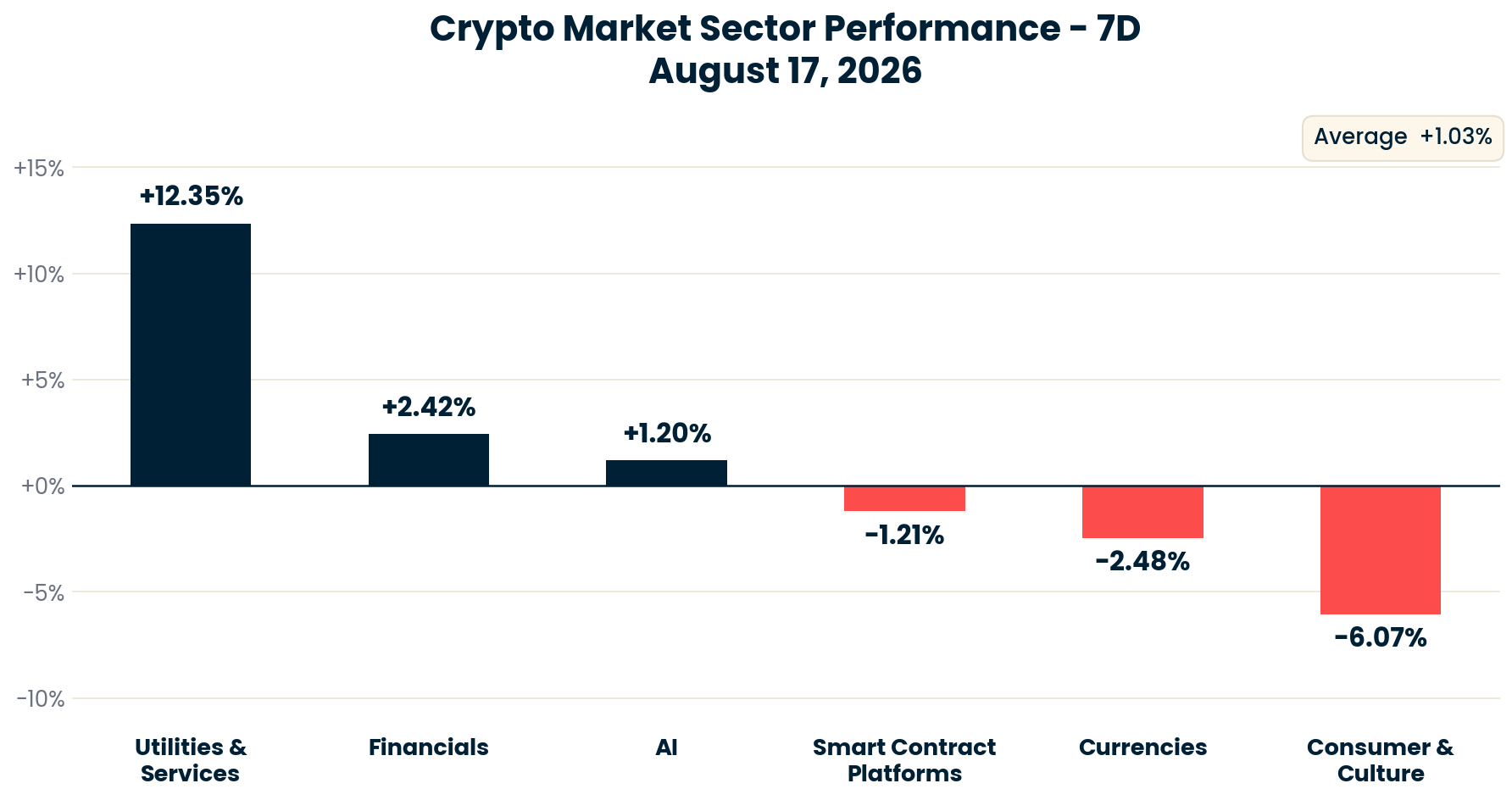
Performance was mixed across crypto this week, with utilities and services leading the gains, though losses across consumer and culture brought down the week's average performance to +1%. The continuation of subdued trading across much of the crypto market is presumably due to continued macroeconomic and geopolitical uncertainty. The crypto fear and greed index lifted to neutral at 40.
Past performance is not a reliable indicator of future results.
Bitcoin (BTC)
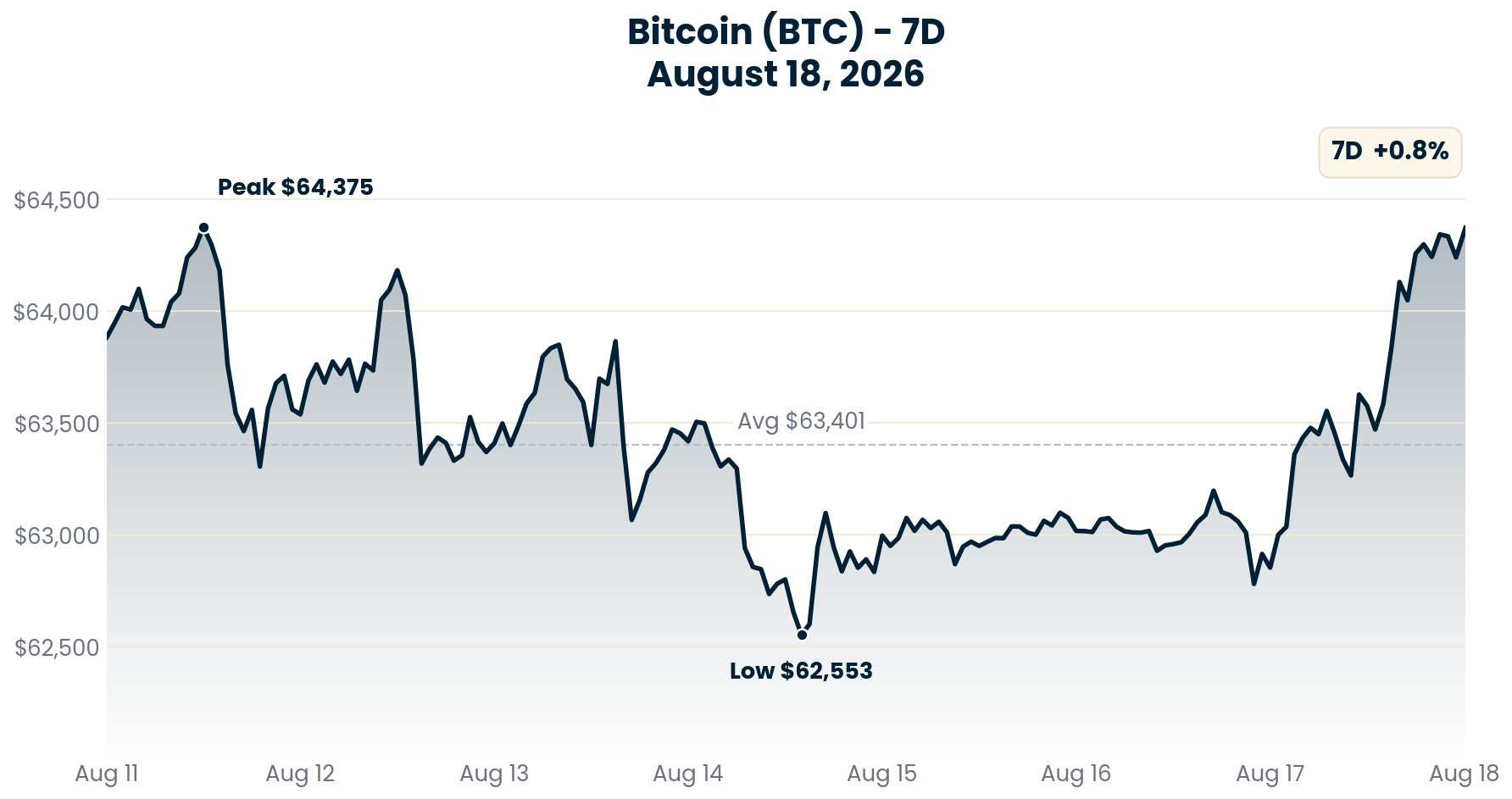
- Opened the week at US$64,857 and declined throughout the week on cooling U.S. economic data, exchange-traded fund outflows, and ongoing Middle East tensions. Bitcoin gained into the new week, presumably as markets anticipate rates remaining on hold at the Fed's September meeting, and is trading around US$64,250 (+0.5% 7D).
- BTC dominance ranged between 58.8% and 59.4% this week.
- Bitcoin investment products saw outflows of US$359.8 million.
While the losses from the Coldcard exploit have slowed, Galaxy Research estimates the attack has stolen at least 1,778 BTC, worth roughly US$112 million, with a suspected fourth wave that may lift losses above US$150 million. Attacks have slowed since August 6, likely because vulnerable users moved their funds or affected wallets have already been drained.
In bitcoin buying (and selling) news:
- Metaplanet denied selling US$320 million in bitcoin, saying a 5,014 BTC transfer was simply a custody move between company addresses. The Japanese firm still holds 43,000 BTC. Meanwhile, it launched BitBonds, a fixed-rate debt program designed to raise capital for potential bitcoin purchases without issuing shares or selling existing holdings.
- Hyperscale Data sold 685 bitcoin for US$43 million to fund expansion of its Michigan data centre and strengthen its capital position, retaining around 275 BTC. The miner plans to continue accumulating bitcoin through mining and future purchases while increasingly pivoting its infrastructure toward artificial intelligence computing and hosting services.
Past performance is not a reliable indicator of future results.
Ethereum (ETH)
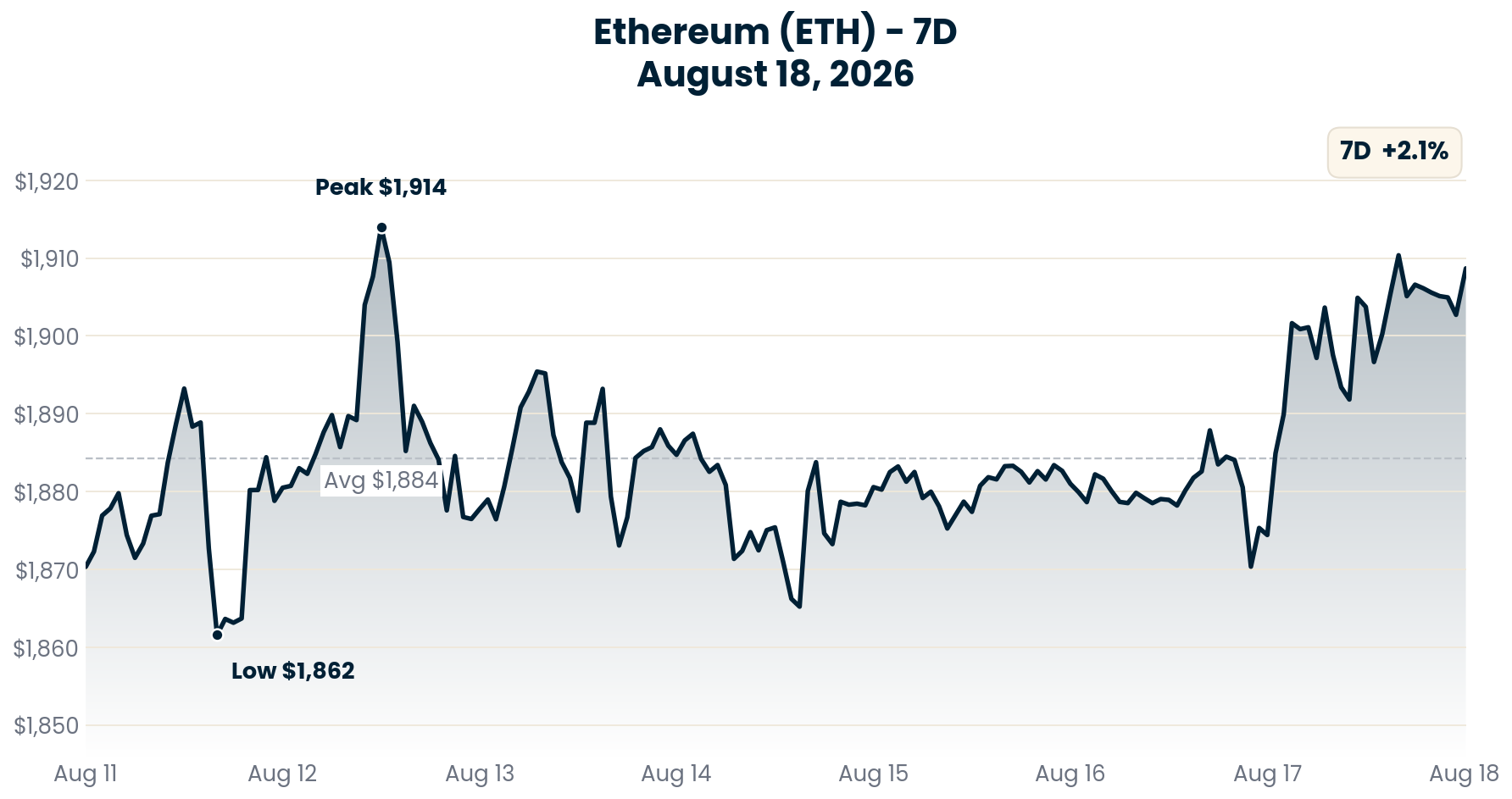
- Opened the week at US$1,909 and traded relatively flat for most of the week. Ethereum gained into the new week, and is now trading around US$1,900 (+1.7% 7D).
- Ethereum dominance ranged between 10.4% and 10.6% this week.
- Ethereum-focused funds saw outflows of US$3.7 million.
Ethereum developers are considering privacy-focused changes for the 2027 Hegotá upgrade. Proposed Frame Transactions could allow privacy pools to pay transaction fees without intermediaries, reducing wallet exposure. FOCIL, already confirmed for Hegotá, would strengthen censorship resistance. The proposals reflect Ethereum's growing focus on native privacy, security and scalability.
SharpLink will stake US$200 million worth of Ethereum through Lido, receiving wstETH that allows it to earn staking rewards while retaining liquidity for DeFi use. The allocation represents roughly 12% of its 888,938 ETH holdings and expands its existing staking strategy as institutional adoption of Ethereum-based treasury strategies grows.
In Ethereum buying news:
- BitMine bought 9,926 ETH (US$19 million). The company now holds over 5.8 million ETH, worth US$11 billion, or around 4.8% of supply.
Past performance is not a reliable indicator of future results.
Altcoins
The altcoin season index is currently 41, which is toward the mid point between bitcoin and altcoin season.
New week, new trading features
- ether.fi gained 28.9%. The decentralised non-custodial liquid staking and re-staking protocol gained on news that it's adding tokenised stock and metals trading, fiat accounts supporting more than 30 currencies, and portfolio-backed loans through Aave. Users can borrow against holdings without selling them. The platform also introduced automated ETHFI buybacks and 3% cash back on card purchases.
Flare x XRP
- XRP declined by 1.1% despite news that token holders can now use Flare's FXRP as collateral to trade options and perpetual futures on decentralised exchange, Derive. The integration lets users hedge, speculate or earn premiums without centralised exchanges. Trades settle in USDC, while FXRP remains collateral.
Lucky SOL
- Solana declined by 0.5%. This week, the network narrowly avoided losing transaction finality after a routing error at hosting provider Teraswitch knocked 28.83% of staked SOL offline, nearing the 33.34% failure threshold. Around 90 validators were affected for 33 minutes. The incident highlighted concerning infrastructure concentration, with one network hosting more than 27% of staked SOL.
Crypto ETF News
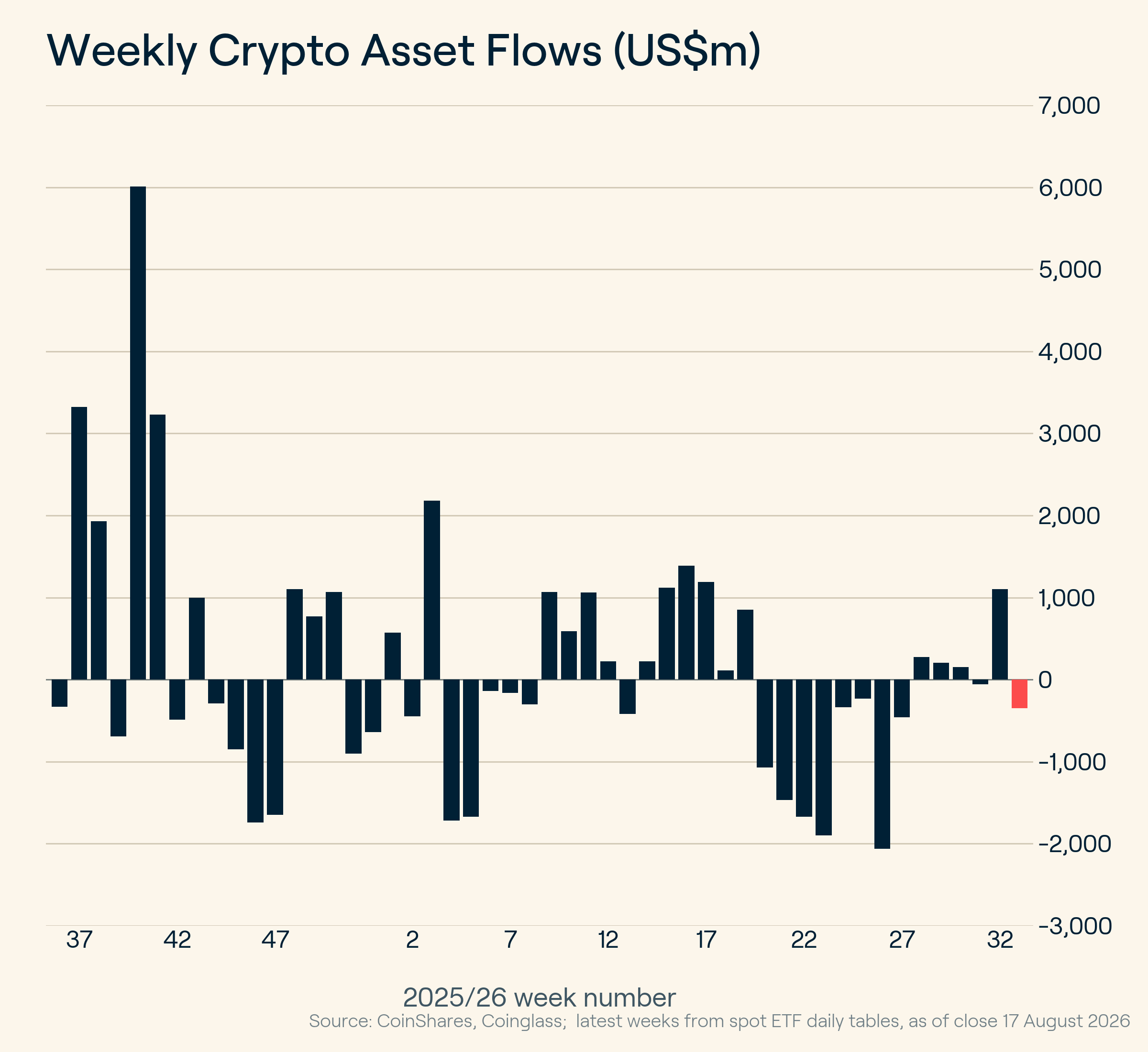
After a couple of weeks where inflows returned, digital asset investment products saw outflows on renewed macroeconomic and geopolitical headwinds, with US$351.1 million leaving funds.
In altcoins, XRP, Solana and HYPE saw inflows of US$2.3 million, US$8.8 million, and US$2.8 million, respectively.
Goldman Sachs agreed to acquire NEOS Investments for up to US$2.25 billion, gaining roughly US$30 billion in options-based ETFs, including its US$1 billion bitcoin covered-call fund. The deal gives Goldman immediate scale in crypto income products, while complementing its April filing for its Bitcoin Premium ETF strategy.
Fidelity filed to allow its spot Ethereum ETF, FETH, to stake up to 100% of its ETH holdings and distribute rewards to investors quarterly in cash. Pending U.S. Securities and Exchange Commission (SEC) approval, the change would make FETH yield-bearing, following similar moves by Grayscale and BlackRock after regulators clarified staking's tax treatment.
Past performance is not a reliable indicator of future results.
Other crypto news
- The US Treasury proposed rules implementing the GENIUS Act, requiring stablecoin issuers to obtain federal or state licences from January 2027. From July 2028, crypto platforms could generally only sell stablecoins from approved issuers to US customers. Foreign issuers would also face US compliance requirements.
- The U.S. SEC cancelled a meeting where commissioners were due to consider the agency's first crypto-specific rules, citing an unforeseen scheduling issue, though sources say the cancellation may have been due to pressure from Wall Street. The proposal would offer tailored securities registration exemptions for crypto startups. The delay follows the Senate's failure to advance the CLARITY Act before its five-week recess, leaving both regulatory routes stalled. A future date is yet to be proposed.
- Trump Media & Technology Group reported a US$238 million second-quarter loss, driven by more than US$190 million in unrealised losses on digital assets, pledged crypto and equities. Its bitcoin and Cronos holdings fell over 33% throughout H1, although management stressed most losses were non-cash accounting changes rather than realised losses.
- The Officer of the Comptroller of the Currency granted preliminary approval for World Liberty Financial's national trust bank, which would issue and redeem its USD1 stablecoin and provide digital asset custody. The Trump-linked venture must maintain US$20 million capital and comply with the GENIUS Act. Critics raised conflict-of-interest concerns, which the regulator largely dismissed.
- Tether received an unqualified audit opinion (best possible result) from KPMG on its 2025 financial statements, marking its first full financial audit after years of scrutiny over USDT reserves. KPMG examined assets, liabilities, cash flows, internal controls and physically inspected Tether's gold holdings, strengthening transparency as the company expands.
- SafePal disclosed a data breach affecting nearly 40,000 customers after attackers exploited an order-tracking plug-in. Names, emails, addresses, phone numbers and purchase details were exposed, though wallet credentials remained secure. The breach raises concerns about physical attacks targeting crypto holders, amid a rise in crypto-related violence globally.
- Ireland launched its first national anti-money laundering strategy, introducing enhanced checks on crypto transfers involving private wallets and stricter due diligence for overseas crypto firms. The measures complete implementation of the EU Transfer of Funds Regulation, including the Financial Action Task Force's travel rule, as Ireland strengthens safeguards against crypto-related financial crime through 2030.
- Russia's central bank published a draft directive, allowing retail investors to trade bitcoin, Ethereum and USDT through regulated intermediaries, capped at 300,000 rubles (US$3,570) annually. The three assets qualified based on liquidity and trading history, while XRP was excluded. Qualified investors face no purchase limits, although all investors must first pass a risk assessment.
- Israel's largest bank, Bank Leumi, plans to offer bitcoin, Ethereum and Solana trading through its Leumi Trade app from early 2027. Galaxy Digital will provide trading and custody infrastructure. The initiative follows a failed 2022 attempt, where trading was to be executed through Paxos. The Bank of Israel rejected the proposal, though recent changes that remove deposit delays and prohibit blanket refusals, prompted the new application.
Inside the Markets
July brought a cautious recovery across crypto. Bitcoin closed the month 7.4% higher and Ethereum gained 18.5% as spot ETF inflows returned following June's record outflows. A hawkish Fed hold, a 21% surge in oil and Strategy's largest-ever bitcoin sale kept conviction in check.
In this month's Inside the Markets, we unpack whether July's institutional bid can hold — Ethereum's 2.5 million ETH validator entry queue, bitcoin's year-to-date ROI against previous midterm cycles, and the August catalysts from FOMC minutes to the CLARITY Act.

from Caleb & Brown Cryptocurrency Brokerage.


