


Market highlights
- Crypto firms urged the U.S. SEC to tailor rules for assessing novel exchange-traded funds.
- CFTC asked federal judge to dismiss CME's lawsuit over Kalshi's bitcoin perpetual futures.
- OpenReserve received preliminary OCC approval to establish a full-service national bank.
- FBI seized approximately US$560,000 in crypto allegedly destined for Hamas' military wing.
- DeFi Development Corp. launched a preferred stock offering to buy additional SOL.
- The G7 urged governments and businesses to begin adopting post-quantum cryptography.
Macro market overview
U.S. markets finished the week broadly flat as rising Treasury yields and renewed Middle East tensions offset intermittent strength in technology stocks. The U.S. Treasury's decision last month to double liquidity-support buybacks of 10-to-30-year securities has so far failed to arrest the rise in long-term borrowing costs, with the 10-year Treasury yield reaching around 4.8%, its highest level since November 2023. Higher oil prices, concerns around U.S. government debt above US$40 trillion and expectations of further Federal Reserve tightening all contributed to the global bond sell-off.
Rate expectations swung throughout the week. Fed Governor Christopher Waller temporarily eased concerns on Thursday after saying he could support leaving rates unchanged if inflation continued to cool, helping the S&P 500 rise more than 1%. However, Friday's stronger-than-expected U.S. employment report reversed some of that optimism. The economy added 162,000 jobs in August, almost three times the 56,000 forecast, while unemployment remained at 4.1%. CME's FedWatch tool currently puts the likelihood of a September rate hike by the U.S. Federal Reserve at 60.4%.
Middle East tensions also returned to the foreground after U.S. forces struck Iranian targets around the Strait of Hormuz and Iran responded with attacks on U.S. positions in Jordan. Further U.S. strikes during the week drove Brent crude above US$94 a barrel and WTI above US$90, increasing concerns that higher energy costs could complicate the Fed's 2% inflation target. The Strait of Hormuz remains partially disrupted, keeping global oil supply risks elevated.
This week, market participants will presumably be watching for developments in the Middle East, clarity around the Fed's September 16 rate decision, global bond markets, and the U.S. producer price index (PPI) and consumer price index (CPI). The European Central Bank (ECB) will also deliver its next rate decision on Thursday, September 10.
Weekly performance: S&P 500 +0.1%, Dow Jones -0.3%, Nasdaq +0.4%.
Looking ahead:
- ECB rate decision - Thursday, September 10
- U.S. PPI – Thursday, September 10
- U.S. CPI – Friday, September 11
Crypto Market Performance
Market Cap: $2.69T (+2.3%)
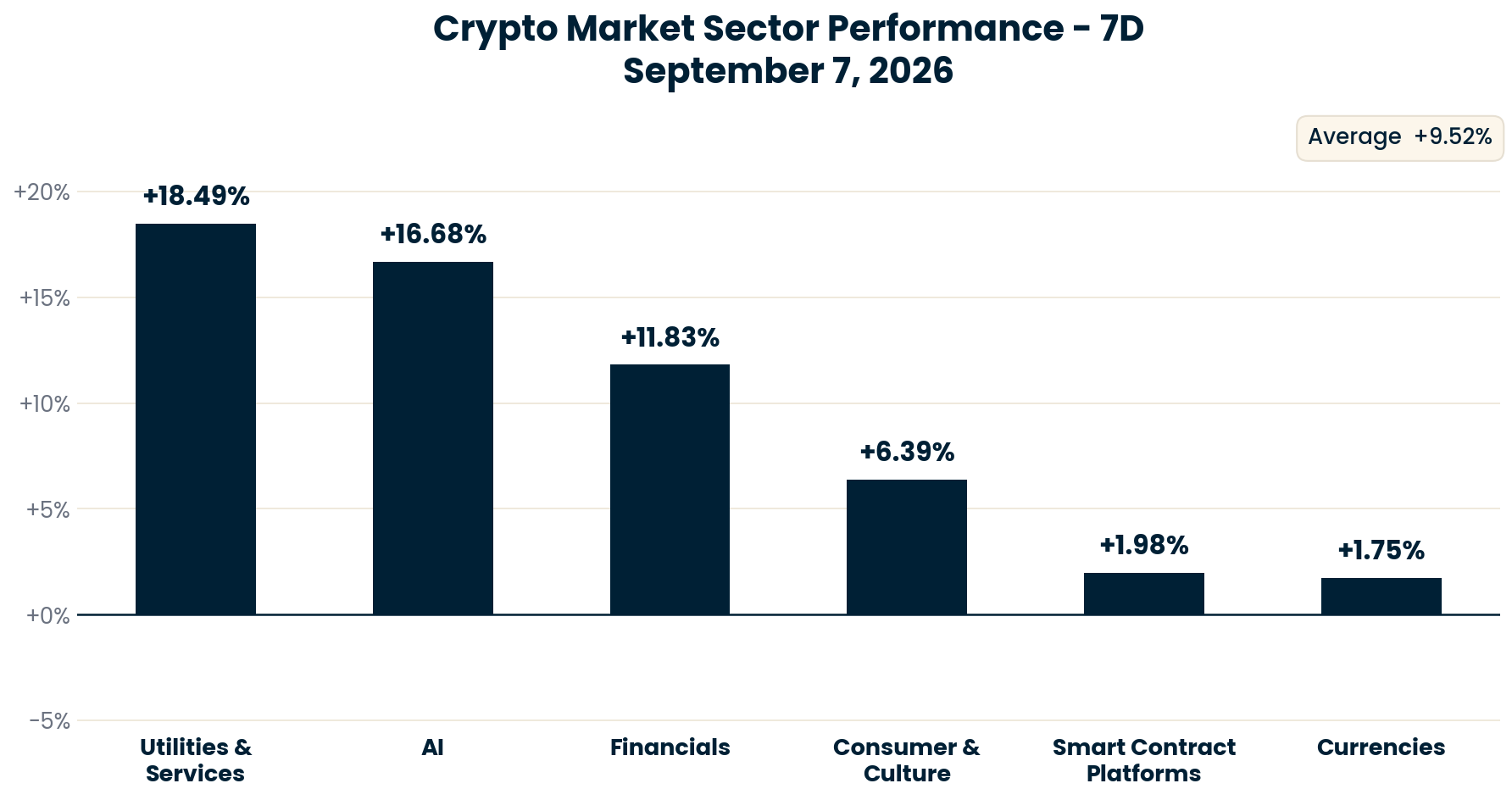
Crypto performance was relatively strong this week and exchange-traded fund (ETF) flows remained strong and market participants showed renewed interest in DeFi, security and data storage networks (more on that below). The crypto fear and greed index remains in "greed" at 73.
Past performance is not a reliable indicator of future results.
Bitcoin (BTC)
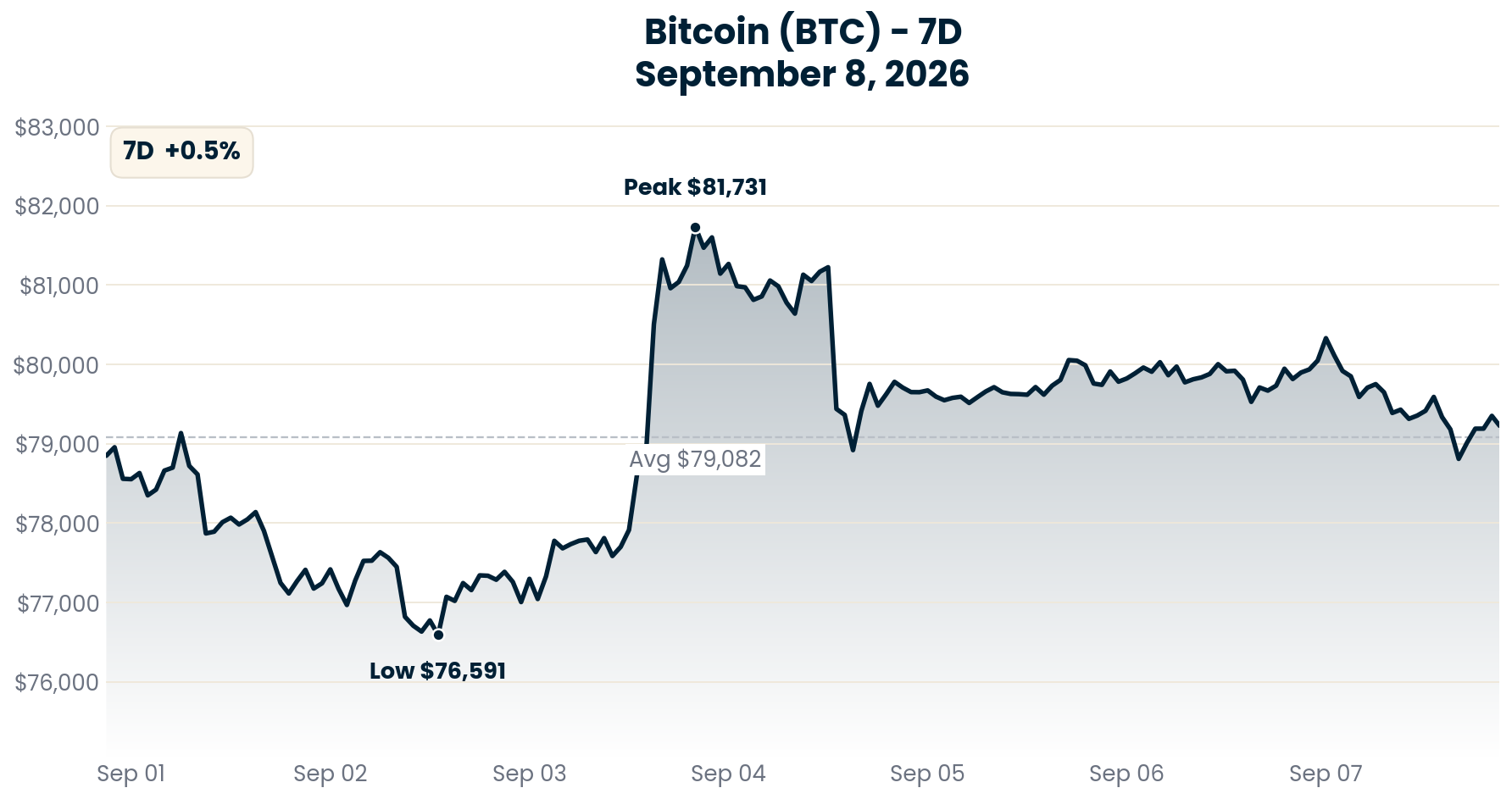
- Opened the week at US$77,659 and gained to a weekly high of US$81,731 on Thursday, September 3, coinciding with market participants seeking alternative assets as Middle East tensions and U.S. interest rate uncertainty added volatility to global markets. Bitcoin declined into the new week and is now trading around US$79,210 (+0.5% 7D).
- BTC dominance ranged between 59.5% and 60.4% this week.
- Bitcoin investment products saw inflows of US$986.7 million.
Four long-dormant bitcoin wallets moved 202.84 BTC worth US$15.7 million between August 29 and September 4. One 2011 wallet turned roughly US$120 into US$3 million, while another sent 6.78 BTC to Coinbase, potentially signalling a sale. The movements extend a 2026 trend of decade-old bitcoin returning to circulation.
Liquid Network halted new transactions after around 4,000 BTC worth US$320 million was withdrawn from its federation wallet by purported white-hat hackers. The funds moved through authorised settlement platform SideSwap, although Liquid said the relevant cryptographic key was not compromised. The incident affected roughly 95% of the wallet's bitcoin.
Hyperscale Data halted bitcoin mining at its Michigan facility to convert the site for an artificial intelligence (AI) customer. The 20-megawatt agreement could generate $1.2 billion over 20 years with extensions, or exceed $3 billion if additional capacity is exercised. Hyperscale plans to sell its mining servers as it transitions to AI infrastructure.
Japan's Remixpoint sold all its Ethereum, Solana, XRP and Dogecoin holdings for almost US$4.5 million, realising a US$598,400 profit. The company will now hold only bitcoin, with approximately 1,500 BTC worth US$116 million, saying the shift will simplify its crypto strategy and improve capital efficiency.
Michael Saylor and Strategy CEO Phong Le urged MSCI to abandon a proposed eligibility screen that could remove Strategy from its global indexes. The rule targets "non-operating companies" using five financial tests. MSCI estimates Strategy, Metaplanet and Yellow Cake would face deletion, with changes potentially taking effect in November.
Past performance is not a reliable indicator of future results.
Ethereum (ETH)
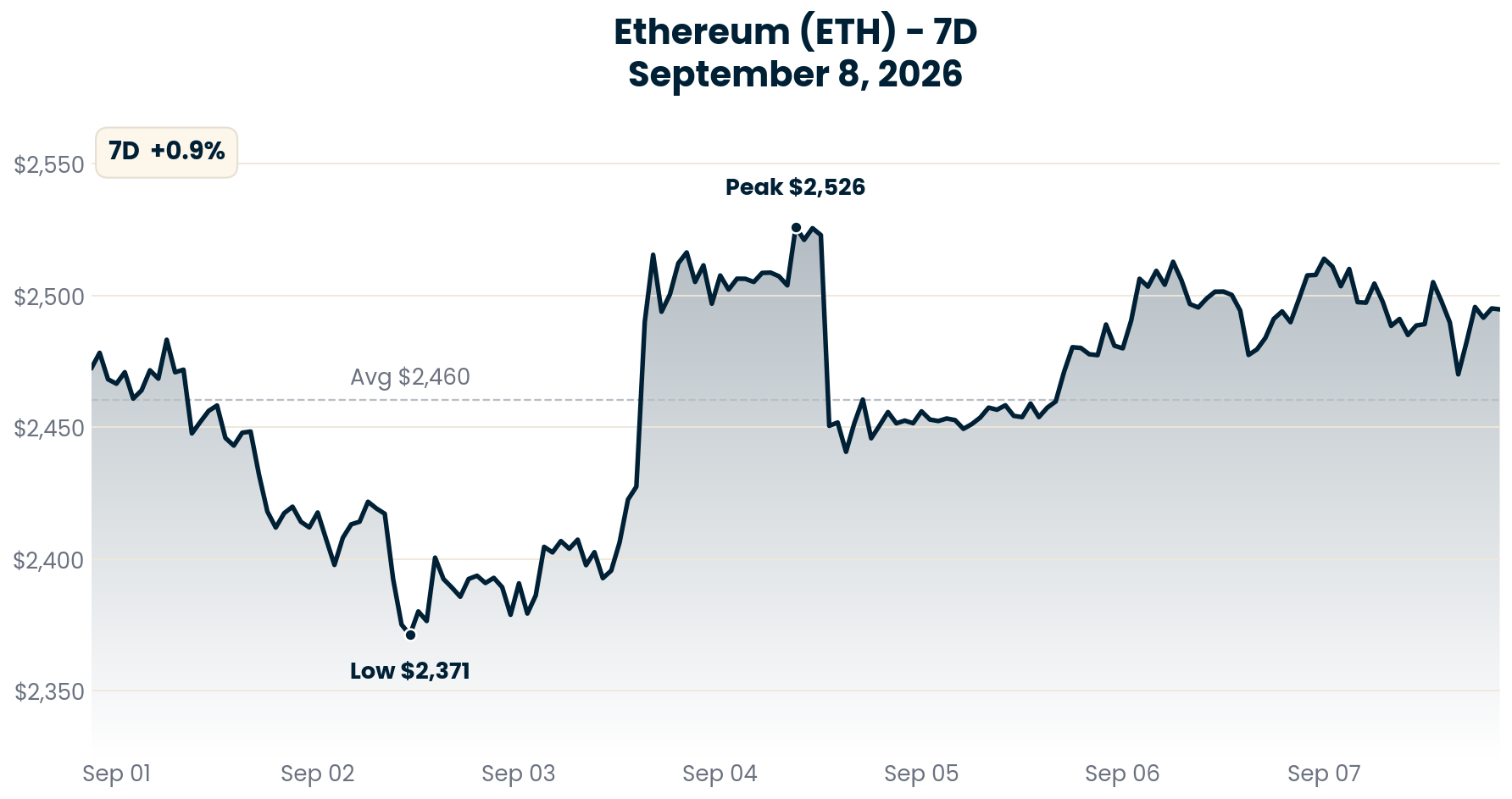
- Opened the week at US$2,415 and gained to a weekly high of US$2,526 on Friday, September 4, presumably as crypto holds steady compared to other risk asset classes as global uncertainties persist. Ethereum declined into the new week, and is now trading around US$2,490 (+0.9% 7D).
- Ethereum dominance ranged between 11.2% and 11.4% this week.
- Ethereum-focused funds saw inflows of US$215.3 million.
BitMine, who holds 5.9 million ETH, around 4.9% of supply, may not need to buy anymore ETH. With more than 5.06 million staked, current yields could generate roughly 135,000 ETH annually, potentially closing its 5% ownership gap without further purchases. However, Ethereum supply growth and BitMine selling rewards for expenses could delay the target.
Past performance is not a reliable indicator of future results.
Altcoins
The altcoin season index is currently 40, which is near the midway point between bitcoin and altcoin season, though still weighted toward bitcoin season.
Merry crypto adventures x Robin Hood
- Arbitrum gained 66.5%. The layer-2 Ethereum scaling network gained on news as investors priced in growing revenue from Robinhood Chain, which pays 10% of net revenue to Arbitrum. Record fees and decentralised exchange (DEX) volumes strengthened ARB's appeal as a direct play on Robinhood Chain's growth and Ethereum Layer-2 adoption.
- Uniswap gained 33.6%. The DEX on the Ethereum chain surged above $US5 to a seven-month high as Robinhood Chain trading volume exceeded US$130 million and accelerating protocol activity drove more than US$300,000 in UNI token burns over 10 days.
- Lighter gained 31.7%, gaining to a record US$4.58, driven by perpetual DEX rotation, strong August trading metrics, token buybacks and Robinhood integration. Speculation around future U.S. market access provided an additional catalyst for the rally.
Layer-1 gains
- Internet Computer gained 28.9%. The layer-1 chain designed to be a decentralised computer saw upward momentum on increased market interest in data security, AI and infrastructure. It started the new week trading just above US$3.
- Celestia gained 28.5%, as market participants showed increased interest in data availability networks, security and data storage. It's trading around US$0.43 to start the new week.
Home run
- XRP gained 0.8%. Ripple, the company that created XRP, signed a multi-year partnership this week with the University of Florida. The deal places XRP branding on the field at Ben Hill Griffin Stadium, digital properties and event signage. Ripple will also fund financial and technology education for student-athletes. The deal follows a similar XRP sponsorship with the University of Kansas.
Crypto ETF News
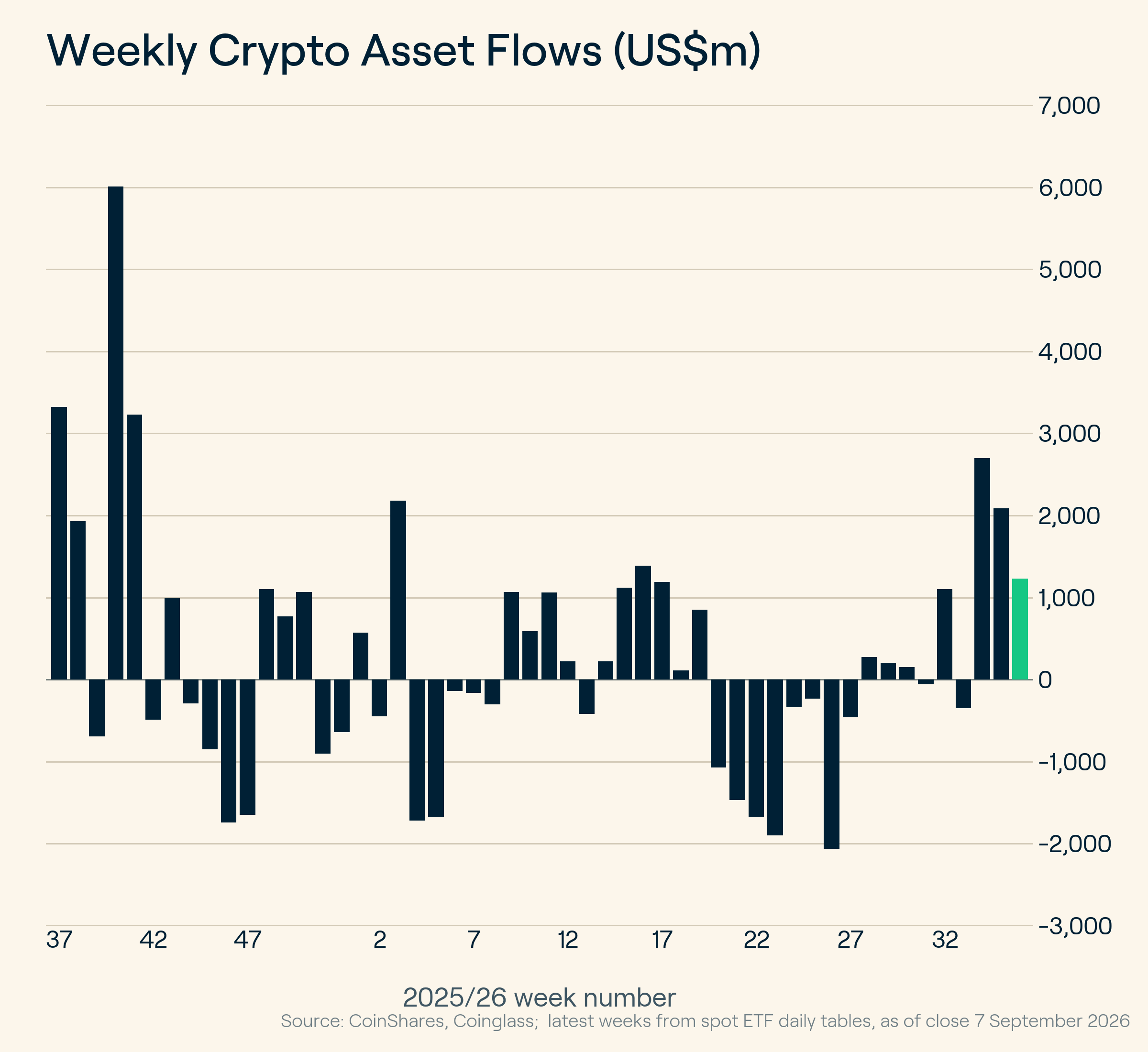
Digital asset investment products saw inflows of over US$1.2 billion for the week as crypto inflows remain strong despite an uncertain macroeconomic and geopolitical backdrop.
In altcoins, XRP, Solana and HYPE saw inflows of US$13.8 million, US$2.09 million, and US$12.3 million, respectively.
Crypto firms including a16z, Grayscale and the Crypto Council for Innovation urged the U.S. Securities and Exchange Commission to tailor rules for novel ETFs rather than regulating them uniformly. Proposals included streamlined approvals for crypto ETFs, retaining existing fund classifications and using blockchain surveillance, while disagreements emerged over event contracts, confidential filings and investor protections.
Past performance is not a reliable indicator of future results.
Other crypto news
- Twenty-one major banks and asset managers, including Goldman Sachs, Bank of America and Citi, plan to launch a U.S. dollar stablecoin by mid-2027. The token will target payments and digital asset settlement, comply with the GENIUS Act and MiCA, with a euro-denominated stablecoin planned to follow.
- The Commodity Futures Trading Commission asked a federal judge to dismiss CME's lawsuit challenging its approval of Kalshi's Bitcoin perpetual futures. The regulator argues CME suffered no financial harm and can list comparable contracts itself. CME contends perpetual contracts should legally be classified as swaps, which would require a different regulatory approval process.
- OpenReserve, which is backed by Andreessen Horowitz and other VC heavyweights, received preliminary Office of the Comptroller of the Currency approval to establish a full-service national bank, allowing it to eventually accept insured deposits and make loans. The a16z-backed firm must raise US$210 million and maintain a 12% Tier 1 leverage ratio. It also plans a separate subsidiary for issuing and custodying dollar-backed stablecoins.
- The U.S. Federal Bureau of Investigation seized approximately US$560,000 in cryptocurrency allegedly destined for Hamas' military wing, the Al Qassam Brigades. Authorities also took control of fundraising domains and servers, enabling them to intercept donations and obtain information on thousands of prospective donors.
- DeFi Development Corp. launched a preferred stock offering targeting US$19.8 million, with most proceeds expected to fund additional Solana purchases. The Nasdaq-listed company recently acquired 19,000 SOL, bringing its treasury to 2.33 million SOL worth around US$236 million, which it also deploys through staking and validator operations.
- The G7 urged governments and businesses to begin adopting post-quantum cryptography, warning future quantum computers could break current encryption and digital signatures. Bitcoin developers are considering BIP-360, while Ethereum is redesigning cryptographic components and Solana has tested post-quantum signatures, as major blockchains prepare for potential quantum-enabled attacks.
from Caleb & Brown Cryptocurrency Brokerage.


